Overdose
Very limited information exists on accidental ingestion of brimonidine in adults;
the only adverse reaction reported to date has been hypotension. Symptoms of
brimonidine overdose have been reported in neonates, infants, and children receiving
ALPHAGAN® P (brimonidine tartrate) as part of medical treatment of congenital glaucoma or
by accidental oral ingestion (see Use In Specific Populations). Treatment
of an oral overdose includes supportive and symptomatic therapy; a patent airway
should be maintained.
Contraindications
Neonates and Infants (under the age of 2 years)
ALPHAGAN® P (brimonidine tartrate) is contraindicated in neonates and infants (under the
age of 2 years).
Hypersensitivity Reactions
ALPHAGAN® P (brimonidine tartrate) is contraindicated in patients who have exhibited a
hypersensitivity reaction to any component of this medication in the past.
Undesirable effects
Clinical Studies Experience
Because clinical studies are conducted under widely varying conditions, adverse
reaction rates observed in the clinical studies of a drug cannot be directly
compared to rates in the clinical studies of another drug and may not reflect
the rates observed in practice.
Adverse reactions occurring in approximately 10-20%of the subjects receiving
brimonidine ophthalmic solution (0.1-0.2%) included: allergic conjunctivitis,
conjunctival hyperemia, and eye pruritus. Adverse reactions occurring in approximately
5-9% included: burning sensation, conjunctival folliculosis, hypertension, ocular
allergic reaction, oral dryness, and visual disturbance.
Adverse reactions occurring in approximately 1-4% of the subjects receiving
brimonidine ophthalmic solution (0.1-0.2%) included: abnormal taste, allergic
reaction, asthenia, blepharitis, blepharoconjunctivitis, blurred vision, bronchitis,
cataract, conjunctival edema, conjunctival hemorrhage, conjunctivitis, cough,
dizziness, dyspepsia, dyspnea, epiphora, eye discharge, eye dryness, eye irritation,
eye pain, eyelid edema, eyelid erythema, fatigue, flu syndrome, follicular conjunctivitis,
foreign body sensation, gastrointestinal disorder, headache, hypercholesterolemia,
hypotension, infection (primarily colds and respiratory infections), insomnia,
keratitis, lid disorder, pharyngitis, photophobia, rash, rhinitis, sinus infection,
sinusitis, somnolence, stinging, superficial punctate keratopathy, tearing, visual field defect, vitreous detachment, vitreous disorder, vitreous floaters,
and worsened visual acuity.
The following reactions were reported in less than 1% of subjects: corneal erosion, hordeolum, nasal dryness, and taste perversion.
Postmarketing Experience
The following reactions have been identified during postmarketing use of brimonidine
tartrate ophthalmic solutions in clinical practice. Because they are reported
voluntarily from a population of unknown size, estimates of frequency cannot
be made. The reactions, which have been chosen for inclusion due to either their
seriousness, frequency of reporting, possible causal connection to brimonidine
tartrate ophthalmic solutions, or a combination of these factors, include: bradycardia,
depression, hypersensitivity, iritis, keratoconjunctivitis sicca, miosis, nausea,
skin reactions (including erythema, eyelid pruritus, rash, and vasodilation),
syncope, and tachycardia. Apnea, bradycardia, coma, hypotension, hypothermia,
hypotonia, lethargy, pallor, respiratory depression, and somnolence have been
reported in infants receiving brimonidine tartrate ophthalmic solutions.
Therapeutic indications
ALPHAGAN® P (brimonidine tartrate ophthalmic solution) 0.1% or 0.15%
is an alpha adrenergic receptor agonist indicated for the reduction of elevated
intraocular pressure (IOP) in patients with open-angle glaucoma or ocular hypertension.
Pharmacokinetic properties
Absorption
After ocular administration of either a 0.1% or 0.2% solution, plasma concentrations
peaked within 0.5 to 2.5 hours and declined with a systemic half-life of approximately
2 hours.
Distribution
The protein binding of brimonidine has not been studied.
Metabolism
In humans, brimonidine is extensively metabolized by the liver.
Excretion
Urinary excretion is the major route of elimination of brimonidine and its
metabolites. Approximately 87% of an orally-administered radioactive dose of
brimonidine was eliminated within 120 hours, with 74% found in the urine.
Date of revision of the text
05/2010
Name of the medicinal product
Alphagan-P
Fertility, pregnancy and lactation
Pregnancy Category B: Teratogenicity studies have been performed in animals.
Brimonidine tartrate was not teratogenic when given orally during gestation
days 6 through 15 in rats and days 6 through 18 in rabbits. The highest doses
of brimonidine tartrate in rats (2.5 mg/kg/day) and rabbits (5.0 mg/kg/day)
achieved AUC exposure values 360- and 20-fold higher, or 260- and 15-fold higher,
respectively, than similar values estimated in humans treated with ALPHAGAN® P (brimonidine tartrate) 0.1% or 0.15%, 1 drop in both eyes three times daily.
There are no adequate and well-controlled studies in pregnant women; however,
in animal studies, brimonidine crossed the placenta and entered into the fetal
circulation to a limited extent. Because animal reproduction studies are not
always predictive of human response, ALPHAGAN® P (brimonidine tartrate) should be used during
pregnancy only if the potential benefit to the mother justifies the potential
risk to the fetus.
Qualitative and quantitative composition
Dosage Forms And Strengths
Solution containing 1 mg/mL or 1.5 mg/mL brimonidine tartrate.
Storage And Handling
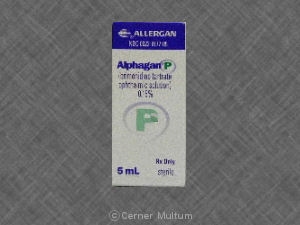
ALPHAGAN® P (brimonidine tartrate) is supplied sterile, in teal opaque plastic LDPE bottles
and tips, with purple high impact polystyrene (HIPS) caps as follows:
0.1%
5 mL in 10 mL bottle NDC 0023-9321-05
10 mL in 10 mL bottle NDC 0023-9321-10
15 mL in 15 mL bottle NDC 0023-9321-15
0.15%
5 mL in 10 mL bottle NDC 0023-9177-05
10 mL in 10 mL bottle NDC 0023-9177-10
15 mL in 15 mL bottle NDC 0023-9177-15
Storage: Store at 15° - 25°C (59° - 77°F).
Allergan, Inc. Irvine, CA 92612, U.S.A. Revised: 05/2010
Special warnings and precautions for use
WARNINGS
Included as part of the PRECAUTIONS section.
PRECAUTIONS
Potentiation of Vascular Insufficiency ALPHAGAN® P (brimonidine tartrate) may potentiate
syndromes associated with vascular insufficiency. ALPHAGAN® P (brimonidine tartrate) should
be used with caution in patients with depression, cerebral or coronary insufficiency,
Raynaud's phenomenon, orthostatic hypotension, or thromboangiitis obliterans.
Severe Cardiovascular Disease
Although brimonidine tartrate ophthalmic solution had minimal effect on the
blood pressure of patients in clinical studies, caution should be exercised
in treating patients with severe cardiovascular disease.
Contamination of Topical Ophthalmic Products After Use
There have been reports of bacterial keratitis associated with the use of multiple-dose
containers of topical ophthalmic products. These containers had been inadvertently
contaminated by patients who, in most cases, had a concurrent corneal disease
or a disruption of the ocular epithelial surface (see PATIENT
INFORMATION).
Nonclinical Toxicology
Carcinogenesis, Mutagenesis, Impairment of Fertility
No compound-related carcinogenic effects were observed in either mice or rats
following a 21month and 24-month study, respectively. In these studies, dietary
administration of brimonidine tartrate at doses up to 2.5 mg/kg/day in mice
and 1 mg/kg/day in rats achieved 150 and 120 times or 90 and 80 times, respectively,
the plasma Cmax drug concentration in humans treated with one drop of ALPHAGAN® P (brimonidine tartrate) 0.1% or 0.15% into both eyes 3 times per day, the recommended daily human
dose.
Brimonidine tartrate was not mutagenic or clastogenic in a series of in
vitro and in vivo studies including the Ames bacterial reversion test, chromosomal
aberration assay in Chinese Hamster Ovary (CHO) cells, and three in vivo studies
in CD1 mice: a host-mediated assay, cytogenetic study, and dominant lethal assay.
Reproduction and fertility studies in rats with brimonidine tartrate demonstrated
no adverse effect on male or female fertility at doses which achieve up to approximately
125 and 90 times the systemic exposure following the maximum recommended human
ophthalmic dose of ALPHAGAN® P (brimonidine tartrate) 0.1% or 0.15%, respectively.
Use In Specific Populations
Pregnancy
Pregnancy Category B: Teratogenicity studies have been performed in animals.
Brimonidine tartrate was not teratogenic when given orally during gestation
days 6 through 15 in rats and days 6 through 18 in rabbits. The highest doses
of brimonidine tartrate in rats (2.5 mg/kg/day) and rabbits (5.0 mg/kg/day)
achieved AUC exposure values 360- and 20-fold higher, or 260- and 15-fold higher,
respectively, than similar values estimated in humans treated with ALPHAGAN® P (brimonidine tartrate) 0.1% or 0.15%, 1 drop in both eyes three times daily.
There are no adequate and well-controlled studies in pregnant women; however,
in animal studies, brimonidine crossed the placenta and entered into the fetal
circulation to a limited extent. Because animal reproduction studies are not
always predictive of human response, ALPHAGAN® P (brimonidine tartrate) should be used during
pregnancy only if the potential benefit to the mother justifies the potential
risk to the fetus.
Nursing Mothers
It is not known whether brimonidine tartrate is excreted in human milk, although
in animal studies, brimonidine tartrate has been shown to be excreted in breast
milk. Because of the potential for serious adverse reactions from ALPHAGAN® P (brimonidine tartrate) in nursing infants, a decision should be made whether to discontinue nursing
or to discontinue the drug, taking into account the importance of the drug to
the mother.
Pediatric Use
ALPHAGAN® P (brimonidine tartrate) is contraindicated in children under the age of 2 years
(see CONTRAINDICATIONS). During postmarketing surveillance, apnea, bradycardia,
coma, hypotension, hypothermia, hypotonia, lethargy, pallor, respiratory depression,
and somnolence have been reported in infants receiving brimonidine. The safety
and effectiveness of brimonidine tartrate have not been studied in children
below the age of 2 years.
In a well-controlled clinical study conducted in pediatric glaucoma patients
(ages 2 to 7 years) the most commonly observed adverse reactions with brimonidine
tartrate ophthalmic solution 0.2% dosed three times daily were somnolence (50-83%
in patients ages 2 to 6 years) and decreased alertness. In pediatric patients
7 years of age ( > 20 kg), somnolence appears to occur less frequently (25%).
Approximately 16% of patients on brimonidine tartrate ophthalmic solution discontinued
from the study due to somnolence.
Geriatric Use
No overall differences in safety or effectiveness have been observed between
elderly and other adult patients.
Special Populations
ALPHAGAN® P (brimonidine tartrate) has not been studied in patients with hepatic impairment.
ALPHAGAN® P (brimonidine tartrate) has not been studied in patients with renal impairment.
The effect of dialysis on brimonidine pharmacokinetics in patients with renal
failure is not known.
Dosage (Posology) and method of administration
The recommended dose is one drop of ALPHAGAN® P (brimonidine tartrate) in the affected
eye(s) three times daily, approximately 8 hours apart. ALPHAGAN® P (brimonidine tartrate)
ophthalmic solution may be used concomitantly with other topical ophthalmic
drug products to lower intraocular pressure. If more than one topical ophthalmic
product is to be used, the different products should be instilled at least 5
minutes apart.
Interaction with other medicinal products and other forms of interaction
SIDE EFFECTS
Clinical Studies Experience
Because clinical studies are conducted under widely varying conditions, adverse
reaction rates observed in the clinical studies of a drug cannot be directly
compared to rates in the clinical studies of another drug and may not reflect
the rates observed in practice.
Adverse reactions occurring in approximately 10-20%of the subjects receiving
brimonidine ophthalmic solution (0.1-0.2%) included: allergic conjunctivitis,
conjunctival hyperemia, and eye pruritus. Adverse reactions occurring in approximately
5-9% included: burning sensation, conjunctival folliculosis, hypertension, ocular
allergic reaction, oral dryness, and visual disturbance.
Adverse reactions occurring in approximately 1-4% of the subjects receiving
brimonidine ophthalmic solution (0.1-0.2%) included: abnormal taste, allergic
reaction, asthenia, blepharitis, blepharoconjunctivitis, blurred vision, bronchitis,
cataract, conjunctival edema, conjunctival hemorrhage, conjunctivitis, cough,
dizziness, dyspepsia, dyspnea, epiphora, eye discharge, eye dryness, eye irritation,
eye pain, eyelid edema, eyelid erythema, fatigue, flu syndrome, follicular conjunctivitis,
foreign body sensation, gastrointestinal disorder, headache, hypercholesterolemia,
hypotension, infection (primarily colds and respiratory infections), insomnia,
keratitis, lid disorder, pharyngitis, photophobia, rash, rhinitis, sinus infection,
sinusitis, somnolence, stinging, superficial punctate keratopathy, tearing, visual field defect, vitreous detachment, vitreous disorder, vitreous floaters,
and worsened visual acuity.
The following reactions were reported in less than 1% of subjects: corneal erosion, hordeolum, nasal dryness, and taste perversion.
Postmarketing Experience
The following reactions have been identified during postmarketing use of brimonidine
tartrate ophthalmic solutions in clinical practice. Because they are reported
voluntarily from a population of unknown size, estimates of frequency cannot
be made. The reactions, which have been chosen for inclusion due to either their
seriousness, frequency of reporting, possible causal connection to brimonidine
tartrate ophthalmic solutions, or a combination of these factors, include: bradycardia,
depression, hypersensitivity, iritis, keratoconjunctivitis sicca, miosis, nausea,
skin reactions (including erythema, eyelid pruritus, rash, and vasodilation),
syncope, and tachycardia. Apnea, bradycardia, coma, hypotension, hypothermia,
hypotonia, lethargy, pallor, respiratory depression, and somnolence have been
reported in infants receiving brimonidine tartrate ophthalmic solutions.
DRUG INTERACTIONS
Antihypertensives/Cardiac Glycosides Because ALPHAGAN® P (brimonidine tartrate) may reduce
blood pressure, caution in using drugs such as antihypertensives and/or cardiac
glycosides with ALPHAGAN® P (brimonidine tartrate) is advised.
CNS Depressants
Although specific drug interaction studies have not been conducted with ALPHAGAN® P (brimonidine tartrate) , the possibility of an additive or potentiating effect with CNS depressants
(alcohol, barbiturates, opiates, sedatives, or anesthetics) should be considered.
Tricyclic Antidepressants
Tricyclic antidepressants have been reported to blunt the hypotensive effect
of systemic clonidine. It is not known whether the concurrent use of these agents
with ALPHAGAN® P (brimonidine tartrate) in humans can lead to resulting interference with
the IOP lowering effect. Caution is advised in patients taking tricyclic antidepressants
which can affect the metabolism and uptake of circulating amines.
Monoamine Oxidase Inhibitors
Monoamine oxidase (MAO) inhibitors may theoretically interfere with the metabolism
of brimonidine and potentially result in an increased systemic side-effect such
as hypotension. Caution is advised in patients taking MAO inhibitors which can
affect the metabolism and uptake of circulating amines.