Overdose
There have been no reports of adverse events associated with overdosage of Proluton Depot in clinical trials. In the case of overdosage, the patient should be treated symptomatically.
Contraindications
Do not use Proluton Depot in women with any of the following conditions:
- Current or history of thrombosis or thromboembolic disorders
- Known or suspected breast cancer, other hormone-sensitive cancer, or history of these conditions
- Undiagnosed abnormal vaginal bleeding unrelated to pregnancy
- Cholestatic jaundice of pregnancy
- Liver tumors, benign or malignant, or active liver disease
- Uncontrolled hypertension
Undesirable effects
For the most serious adverse reactions to the use of progestins, see WARNINGS AND PRECAUTIONS.
Clinical Trials Experience
Because clinical trials are conducted under widely varying conditions, adverse reaction rates observed in the clinical trials of a drug cannot be directly compared to the rates in the clinical trials of another drug and may not reflect the rates observed in practice.
In a vehicle (placebo)-controlled clinical trial of 463 pregnant women at risk for spontaneous preterm delivery based on obstetrical history, 310 received 250 mg of Proluton Depot and 153 received a vehicle formulation containing no drug by a weekly intramuscular injection beginning at 16 to 20 weeks of gestation and continuing until 37 weeks of gestation or delivery, whichever occurred first.1
Certain pregnancy-related fetal and maternal complications or events were numerically increased in the Proluton Depot-treated subjects as compared to control subjects, including miscarriage and stillbirth, admission for preterm labor, preeclampsia or gestational hypertension, gestational diabetes, and oligohydramnios (Tables 1 and 2).
Table 1 : Selected Fetal Complications
| Pregnancy Complication | Proluton Depot
n/N | Control
n/N |
| Miscarriage (< 20 weeks)1 | 5/209 | 0/107 |
| Stillbirth (≥ 20 weeks)2 | 6/305 | 2/153 |
1 N = Total number of subjects enrolled prior to 20 weeks 0 days
2 N = Total number of subjects at risk ≥ 20 weeks |
Table 2 : Selected Maternal Complications
| Pregnancy Complication | Proluton Depot
N=310 % | Control
N=153 % |
| Admission for preterm labor1 | 16.0 | 13.8 |
| Preeclampsia or gestational hypertension | 8.8 | 4.6 |
| Gestational diabetes | 5.6 | 4.6 |
| Oligohydramnios | 3.6 | 1.3 |
| 1 Other than delivery admission. |
Common Adverse Reactions
The most common adverse reaction was injection site pain, which was reported after at least one injection by 34.8% of the Proluton Depot group and 32.7% of the control group. Table 3 lists adverse reactions that occurred in ≥ 2% of subjects and at a higher rate in the Proluton Depot group than in the control group.
Table 3 : Adverse Reactions Occurring in ≥ 2% of Proluton Depot-Treated Subjects and at a Higher Rate than Control Subjects
| Preferred Term | Proluton Depot
N=310 % | Control
N=153 % |
| Injection site pain | 34.8 | 32.7 |
| Injection site swelling | 17.1 | 7.8 |
| Urticaria | 12.3 | 11.1 |
| Pruritus | 7.7 | 5.9 |
| Injection site pruritus | 5.8 | 3.3 |
| Nausea | 5.8 | 4.6 |
| Injection site nodule | 4.5 | 2.0 |
| Diarrhea | 2.3 | 0.7 |
In the clinical trial, 2.2% of subjects receiving Proluton Depot were reported as discontinuing therapy due to adverse reactions compared to 2.6% of control subjects. The most common adverse reactions that led to discontinuation in both groups were urticaria and injection site pain/swelling (1% each).
Pulmonary embolus in one subject and injection site cellulitis in another subject were reported as serious adverse reactions in Proluton Depot-treated subjects.
Postmarketing Experience
The following adverse reactions have been identified during postapproval use of Proluton Depot. Because these reactions are reported voluntarily from a population of uncertain size, it is not always possible to reliably estimate their frequency or establish a causal relationship to drug exposure.
- Body as a whole: Local injection site reactions (including erythema, urticaria, rash, irritation, hypersensitivity, warmth); fatigue; fever; hot flashes/flushes
- Digestive disorders: Vomiting
- Infections: Urinary tract infection
- Nervous system disorders: Headache, dizziness
- Pregnancy, puerperium and perinatal conditions: Cervical incompetence, premature rupture of membranes
- Reproductive system and breast disorders: Cervical dilation, shortened cervix
- Respiratory disorders: Dyspnea, chest discomfort
- Skin: Rash
Therapeutic indications
Proluton Depot is a progestin indicated to reduce the risk of preterm birth in women with a singleton pregnancy who have a history of singleton spontaneous preterm birth. The effectiveness of Proluton Depot is based on improvement in the proportion of women who delivered < 37 weeks of gestation. There are no controlled trials demonstrating a direct clinical benefit, such as improvement in neonatal mortality and morbidity.
Limitation Of Use
While there are many risk factors for preterm birth, safety and efficacy of Proluton Depot has been demonstrated only in women with a prior spontaneous singleton preterm birth. It is not intended for use in women with multiple gestations or other risk factors for preterm birth.
Pharmacodynamic properties
No specific pharmacodynamic studies were conducted with Proluton Depot.
Pharmacokinetic properties
Absorption
Female patients with a singleton pregnancy received intramuscular doses of 250 mg hydroxyprogesterone caproate for the reduction of preterm birth starting between 16 weeks 0 days and 20 weeks 6 days. All patients had blood drawn daily for 7 days to evaluate pharmacokinetics.
Table 4 : Summary of Mean (Standard Deviation) PK Parameters for Hydroxyprogesterone Caproate
| Group (N) | Cmax (ng/mL) | Tmax (days)a | AUC(1-t)b (ng•hr/mL) |
| Group 1 (N=6) | 5.0 (1.5) | 5.5 (2.0-7.0) | 571.4 (195.2) |
| Group 2 (N=8) | 12.5 (3.9) | 1.0 (0.9-1.9) | 1269.6 (285.0) |
| Group 3 (N=11) | 12.3 (4.9) | 2.0 (1.0-3.0) | 1268.0 (511.6) |
Blood was drawn daily for 7 days (1) starting 24 hours after the first dose between Weeks 1620 (Group 1), (2) after a dose between Weeks 24-28 (Group 2), or (3) after a dose between Weeks 32-36 (Group 3)
a Reported as median (range)
b t = 7 days |
For all three groups, peak concentration (Cmax) and area under the curve (AUC(1-7 days)) of the mono-hydroxylated metabolites were approximately 3-8fold lower than the respective parameters for the parent drug, hydroxyprogesterone caproate. While di-hydroxylated and tri-hydroxylated metabolites were also detected in human plasma to a lesser extent, no meaningful quantitative results could be derived due to the absence of reference standards for these multiple hydroxylated metabolites. The relative activity and significance of these metabolites are not known.
The elimination half-life of hydroxyprogesterone caproate, as evaluated from 4 patients in the study who reached full-term in their pregnancies, was 16.4 (±3.6) days. The elimination half-life of the mono-hydroxylated metabolites was 19.7 (±6.2) days.
Distribution
Hydroxyprogesterone caproate binds extensively to plasma proteins including albumin and corticosteroid binding globulins.
Metabolism
In vitro studies have shown that hydroxyprogesterone caproate can be metabolized by human hepatocytes, both by phase I and phase II reactions. Hydroxyprogesterone caproate undergoes extensive reduction, hydroxylation and conjugation. The conjugated metabolites include sulfated, glucuronidated and acetylated products. In vitro data indicate that the metabolism of hydroxyprogesterone caproate is predominantly mediated by CYP3A4 and CYP3A5. The in vitro data indicate that the caproate group is retained during metabolism of hydroxyprogesterone caproate.
Excretion
Both conjugated metabolites and free steroids are excreted in the urine and feces, with the conjugated metabolites being prominent. Following intramuscular administration to pregnant women at 10-12 weeks gestation, approximately 50% of a dose was recovered in the feces and approximately 30% recovered in the urine.
Name of the medicinal product
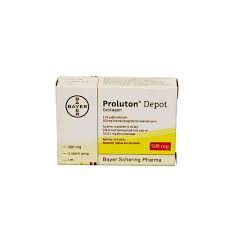
Proluton Depot
Qualitative and quantitative composition
Hydroxyprogesterone
Special warnings and precautions for use
WARNINGS
Included as part of the PRECAUTIONS section.
PRECAUTIONS Thromboembolic Disorders
Discontinue Proluton Depot if an arterial or deep venous thrombotic or thromboembolic event occurs.
Allergic Reactions
Allergic reactions, including urticaria, pruritus and angioedema, have been reported with use of Proluton Depot or with other products containing castor oil. Consider discontinuing the drug if such reactions occur.
Decrease In Glucose Tolerance
A decrease in glucose tolerance has been observed in some patients on progestin treatment. The mechanism of this decrease is not known. Carefully monitor prediabetic and diabetic women while they are receiving Proluton Depot.
Fluid Retention
Because progestational drugs may cause some degree of fluid retention, carefully monitor women with conditions that might be influenced by this effect (e.g., preeclampsia, epilepsy, migraine, asthma, cardiac or renal dysfunction).
Depression
Monitor women who have a history of clinical depression and discontinue Proluton Depot if clinical depression recurs.
Jaundice
Carefully monitor women who develop jaundice while receiving Proluton Depot and consider whether the benefit of use warrants continuation.
Hypertension
Carefully monitor women who develop hypertension while receiving Proluton Depot and consider whether the benefit of use warrants continuation.
Patient Counseling Information
See FDA-approved patient labeling (PATIENT INFORMATION).
Counsel patients that Proluton Depot injections may cause pain, soreness, swelling, itching or bruising. Inform the patient to contact her physician if she notices increased discomfort over time, oozing of blood or fluid, or inflammatory reactions at the injection site.
Nonclinical Toxicology Carcinogenesis, Mutagenesis, Impairment Of Fertility
Hydroxyprogesterone caproate has not been adequately evaluated for carcinogenicity.
No reproductive or developmental toxicity or impaired fertility was observed in a multigenerational study in rats. Proluton Depot administered intramuscularly, at gestational exposures up to 5 times the recommended human dose, had no adverse effects on the parental (F0) dams, their developing offspring (F1), or the latter offspring's ability to produce a viable, normal second (F2) generation.
Use In Specific Populations Pregnancy Pregnancy Category B
There are no adequate and well-controlled studies of Proluton Depot use in women during the first trimester of pregnancy. Data from a vehicle (placebo)-controlled clinical trial of 310 pregnant women who received Proluton Depot at weekly doses of 250 mg by intramuscular injection in their second and third trimesters1, as well as long-term (2-5 years) follow-up safety data on 194 of their infants2, did not demonstrate any teratogenic risks to infants from in utero exposure to Proluton Depot.
Reproduction studies have been performed in mice and rats at doses up to 95 and 5, respectively, times the human dose and have revealed no evidence of impaired fertility or harm to the fetus due to Proluton Depot.
Proluton Depot administration produced embryolethality in rhesus monkeys but not in cynomolgus monkeys exposed to 1 and 10 times the human dose equivalent every 7 days between days 20 and 146 of gestation. There were no teratogenic effects in either species.
Labor And Delivery
Proluton Depot is not intended for use to stop active preterm labor. The effect of Proluton Depot in active labor is unknown.
Nursing Mothers
Discontinue Proluton Depot at 37 weeks of gestation or upon delivery. Detectable amounts of progestins have been identified in the milk of mothers receiving progestin treatment. Many studies have found no adverse effects of progestins on breastfeeding performance, or on the health, growth, or development of the infant.
Pediatric Use
Proluton Depot is not indicated for use in children. Safety and effectiveness in pediatric patients less than 16 years of age have not been established. A small number of women under age 18 years were studied; safety and efficacy are expected to be the same in women aged 16 years and above as for users 18 years and older.
Geriatric Use
Proluton Depot is not intended for use in postmenopausal women. Safety and effectiveness in postmenopausal women have not been established.
Renal Impairment
No studies have been conducted to examine the pharmacokinetics of Proluton Depot in patients with renal impairment.
Hepatic Impairment
No studies have been conducted to examine the pharmacokinetics of Proluton Depot in patients with hepatic impairment. Proluton Depot is extensively metabolized and hepatic impairment may reduce the elimination of Proluton Depot.
Dosage (Posology) and method of administration
Dosing
- Administer intramuscularly at a dose of 250 mg (1 mL) once weekly (every 7 days) by a healthcare provider
- Begin treatment between 16 weeks, 0 days and 20 weeks, 6 days of gestation
- Continue administration once weekly until week 37 (through 36 weeks, 6 days) of gestation or delivery, whichever occurs first
Preparation And Administration
Parenteral drug products should be inspected visually for particulate matter and discoloration prior to administration, whenever solution and container permit. Proluton Depot is a clear, yellow solution. Do not use if solid particles appear or if the solution is cloudy.
Instructions For Administration
- Clean the vial top with an alcohol swab before use.
- Draw up 1 mL of drug into a 3 mL syringe with an 18 gauge needle.
- Change the needle to a 21 gauge 1½ inch needle.
- After preparing the skin, inject in the upper outer quadrant of the gluteus maximus. The solution is viscous and oily. Slow injection (over one minute or longer) is recommended.
- Applying pressure to the injection site may minimize bruising and swelling.
If the 5 mL multidose vial is used, discard any unused product 5 weeks after first use.