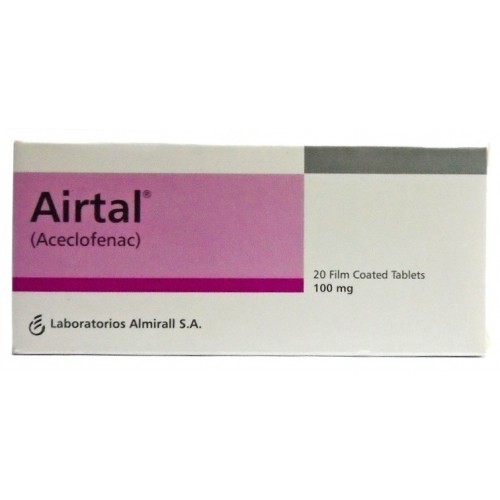
Airtal is a nonsteroidal anti-inflammatory medication based on aceclofenac, registered in ten countries spanning southern Europe, the Baltic region, the Caucasus, the Middle East, and East Africa. Its footprint is moderate rather than global — a reader who has used Airtal in Spain or Italy may or may not find the same brand on a pharmacy shelf elsewhere, depending on which regulatory market they have travelled into.
Aceclofenac is used in the management of pain and a range of inflammatory joint conditions, including osteoarthritis, rheumatoid arthritis, and ankylosing spondylitis, as well as more general musculoskeletal pain. The structured indication list further down this page details the registered uses recognised by national regulators in the markets where Airtal is sold. Aceclofenac is positioned within the broader nonsteroidal anti-inflammatory class, the same therapeutic category that includes a number of long-established molecules used for inflammatory joint disease worldwide.
Travellers and expatriates encountering Airtal in markets such as Spain, Italy, Russia, Lebanon, or Kenya will find that the brand and its accompanying packaging vary by country, and the regulatory pathway — whether prescription-only or pharmacist-supplied — depends on local rules rather than the molecule itself. The aceclofenac molecule also circulates internationally under several other brand names, particularly in markets where the original patent has lapsed and generic manufacturers produce parallel versions.
Other members of the nonsteroidal anti-inflammatory class are widely sold across essentially every regulated market in the world, although they are not freely interchangeable — molecules within the class differ in their clinical positioning. A local pharmacist can identify what is available regionally, and any decision to start, stop, or substitute aceclofenac should be made together with a healthcare provider familiar with the patient's circumstances.