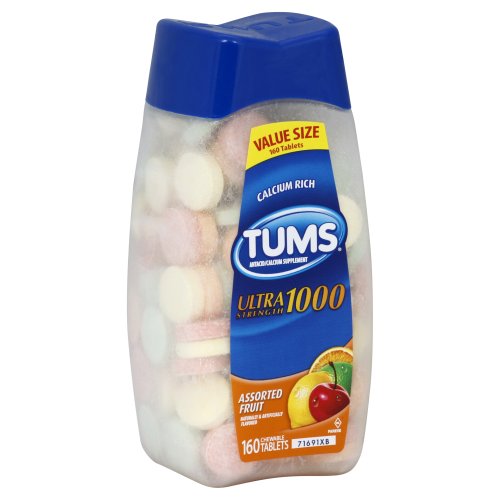
Tums has a relatively narrow international footprint, registered in seven countries that span several continents rather than clustering in one region — Argentina, Canada, Israel, the Philippines, Portugal, the United Kingdom, and the United States. The brand is long-established in some of these markets, particularly North America and the United Kingdom, where it is a familiar fixture on pharmacy and supermarket shelves.
The active ingredient is calcium carbonate, classified within the antacid category and also recognised as a mineral used in compensating calcium deficiency. In its Tums formulation the ingredient is positioned for the symptomatic relief of dyspepsia, heartburn, and flatulence — common complaints linked to excess stomach acid. The structured indication list further down this page sets out the registered uses in the markets where Tums is sold.
Travellers familiar with Tums from North America or the UK will not always find the same brand abroad, even though calcium carbonate itself is one of the most universally available active ingredients in the world. In countries where Tums is not registered, the same molecule is typically sold under a different antacid brand name, and other mineral-based antacids in the same broader class are also widely available.
A pharmacist in the destination country is the right person to point out a locally registered calcium carbonate product, or a comparable antacid if calcium carbonate is not the preferred option there. While antacids are often sold without prescription, recurring or persistent symptoms of indigestion or heartburn are worth raising with a healthcare provider rather than managing indefinitely on over-the-counter products alone.
Overdose
Hypercalcaemia -Remove source of calcium. Rehydration may be necessary (if necessary with intravenous 0.9% sodium chloride) and a loop diuretic may be given to increase urinary calcium excretion.
Shelf life
3 years.
Incompatibilities
None known.
List of excipients
All Flavour Tablets
Microcrystalline Cellulose
Maize Starch
Dextrose Monohydrate
Sodium Saccharin
Magnesium Stearate
Blackcurrant Flavour Tablets
Patent Blue V Lake E131
Ponceau 4R Lake E124
Blackcurrant Flavour 9/696044
Cherry Flavour Tablets
Ponceau 4R Lake E124
Cherry Flavour 630277F
Lemon Flavour Tablets
Quinoline Yellow Lake E104
Lemon Flavour 610364E
Orange Flavour Tablets
Sunset Yellow Lake E110
Orange Flavour 655280 SD
Undesirable effects
Calcium Carbonate can cause constipation and flatulence. Hypercalcaemia can occur as can alkalosis following the regular use of Calcium Carbonate. The milk-alkali syndrome has occasionally occurred in patients taking large doses. 'Acid Rebound' has been reported on cessation of Calcium Carbonate.
Reporting of suspected adverse reactions
Reporting suspected adverse reactions after authorisation of the medicinal product is important. It allows continued monitoring of the benefit/risk balance of the medicinal product. Healthcare professionals are asked to report any suspected adverse reactions via the Yellow Card Scheme at: www.mhra.gov.uk/yellowcard.
Preclinical safety data
Not applicable.
Pharmacodynamic properties
Antacid.
Mechanism of Action/Effect
Calcium Carbonate reacts chemically to neutralise or buffer existing quantities of stomach acid but has no direct effect on its output. This action results in increased pH value of stomach contents, thus providing relief of hyperacidity symptoms. It also reduces acid concentration within the lumen of the oesophagus, thus causing an increase in intra-oesophageal pH and a decrease in pepsin activity, which aids the control of gastro-oesophageal reflux.
ATC code: A02AC01.
Pharmacokinetic properties
Not applicable.
Date of revision of the text
03/01/2018
Marketing authorisation holder
Wrafton Laboratories Limited Wrafton Braunton North Devon EX33 2DL
Special precautions for storage
Do not store above 25°C.
Nature and contents of container
250 micron clear white UPVC/20 micron hard temper, heat seal coated aluminium foil. 24, 48, 72, 96 tablets/carton.
Polypropylene bottle with polyethylene tamper evident caps 72, 75, 95, 100 tablets/bottle.
Roll wrap of 20 tablets in 9 micron soft aluminium foil/6 gsm wax/20 gsm paper. 40, 60, 80, 100, 120 packs will be 2, 3, 4, 5, 6 rolls in a carton.
Roll wrap of 12 tablets in 9 micron soft aluminium foil/6 gsm wax/20 gsm paper. 24, 36, 48, 60, 72, 96 packs will be 2, 3, 4, 5, 6, 8 rolls in a carton.
Marketing authorisation number(s)
PL 12063/0013.
Special warnings and precautions for use
If symptoms persist consult your doctor. Keep all medicines out of the sight and reach of children.
The leaflet shall say:
Each tablet contains 523 mg of glucose (dextrose) per tablet. This should be taken into account in patients with diabetes mellitus.
If you have been told by your doctor that you have an intolerance to some sugars, contact your doctor before taking this medicinal product.
Effects on ability to drive and use machines
None known.
Special precautions for disposal and other handling
None.
ADMINISTRATION DETAILS
Date of first authorisation/renewal of the authorisation
28 July1993