Overdose
There has been no experience of overdosage with Selexid. However, excessive doses of Selexid are likely to induce nausea, vomiting, abdominal pain and diarrhoea. Treatment should be restricted to symptomatic and supportive measures.
Shelf life
3 years
Contraindications
Hypersensitivity to penicillins and/or cephalosporins. Any conditions resulting in impaired transit through the oesophagus.
Genetic metabolism anomalies known to be leading to severe carnitine deficiency, such as carnitine transporter defect, methylmalonic aciduria or propionic acidaemia.
Incompatibilities
Not applicable.
List of excipients
Cellulose microcrystalline
Hydroxypropyl cellulose
Magnesium stearate
Hypromellose
Simethicone
Paraffin, synthetic
Pharmaceutical form
Film-coated tablet
A white circular film-coated convex tablet embossed with an Assyrian lion on one side and 137 on the other.
Undesirable effects
The estimation of the frequency of undesirable effects is based on an analysis of pooled data from clinical studies and spontaneous reporting.
The most frequently reported undesirable effects are nausea and diarrhoea.
Anaphylactic reactions and fatal pseudomembranous colitis have been reported.
Undesirable effects are listed by MedDRA SOC and the individual undesirable effects are listed starting with the most frequently reported. Within each frequency grouping, adverse reactions are presented in the order of decreasing seriousness.
Very common > 1/10
Common > 1/100 and < 1/10
Uncommon > 1/1,000 and < 1/100
Rare > 1/10,000 and < 1/1,000
Very Rare < 1/10,000
| Infections and infestations
|
| Common:
| Vulvovaginal mycotic infection
|
| Uncommon:
| Clostridium difficile colitis
|
| Blood and lymphatic system disorders
|
| Uncommon:
| Thrombocytopenia
|
| Immune system disorders
|
| Uncommon:
| Anaphylactic reaction
|
| Metabolism and nutrition disorders
|
| Uncommon:
| Carnitine decreased
|
| Nervous system disorders
|
| Uncommon:
| Headache
Dizziness
|
| Ear and labyrinth disorders
|
| Uncommon:
| Vertigo
|
| Gastrointestinal disorders
|
| Common:
| Diarrhoea
Nausea
|
| Uncommon:
| Vomiting
Abdominal pain
Dyspepsia
Oesophageal ulcer
Oesophagitis
Mouth ulceration
|
| Hepatobiliary disorders
|
| Uncommon:
| Hepatic function abnormal
|
| Skin and subcutaneous tissue disorders
|
| Uncommon:
| Rash*
Urticaria
Pruritus
|
| General disorders and administration site conditions
|
| Uncommon:
| Fatigue
|
*Various types of rash reactions such as erythematous, macular or maculo-papular have been reported
Class adverse reactions of beta-lactam antibiotics:
Slight reversible increase in ASAT, ALAT, alkaline phosphatase, and bilirubin
Neutropenia
Eosinophilia
Paediatric population
Frequency, type and severity of adverse reactions in children are expected to be the same as in adults, based on limited data.
Reporting of suspected adverse reactions
Reporting suspected adverse reactions after authorisation of the medicinal product is important. It allows continued monitoring of the benefit/risk balance of the medicinal product. Healthcare professionals are asked to report any suspected adverse reactions via the Yellow Card Scheme at www.mhra.gov.uk/yellowcard.
Preclinical safety data
There are no pre-clinical data of relevance to the prescriber which are additional to that already included in other sections of the SPC.
Therapeutic indications
Selexid is indicated for the treatment of infections due to mecillinam sensitive organisms , including:
- urinary tract infections
- salmonellosis
Preliminary experience in a small number of patients suggests that Selexid tablets may be a useful alternative antibiotic in the treatment of acute typhoid fever and in some carriers of salmonellae when antibiotic treatment is considered essential.
Consideration should be given to official guidance on the appropriate use of antibacterial agents.
Pharmacotherapeutic group
antibacterial products for systemic use, penicillins with extended spectrum, ATC code: J01CA08
Pharmacodynamic properties
Pharmacotherapeutic group: antibacterial products for systemic use, penicillins with extended spectrum, ATC code: J01CA08
Selexid is an orally active antibiotic. Chemically it is the pivaloyloxymethylester of the amidinopenicillanic acid, mecillinam. On oral administration it is well absorbed and subsequently hydrolysed in the body to mecillinam, the active antibacterial agent, by non-specific esterases present in blood, gastro-intestinal mucosa and other tissues.
Selexid is highly active against most enterobacteriaceae, including E. coli, Klebsiella, Proteus, Enterobacter, Serratia, Salmonella, Shigella and Yersina.
Selexid is less active against gram positive bacteria and organisms such as Pseudomonas aeruginosa and Streptococcus faecalis are practically resistant to mecillinam.
Whilst Selexid, like the penicillins and cephalosporins, interferes with the biosynthesis of the bacterial cell wall, the target of the inhibition is different. This different mode of action is probably responsible for the synergistic action which has been found, both in vitro and in vivo, between Selexid and various penicillins and cephalosporins.
Pharmacokinetic properties
Peak serum levels of mecillinam averaging 5 microgram/ml are reached after 1 hour following a dose of 10 mg/kg body weight in children and 400 mg in adults.
The serum half-life is 1.2 hours. The protein binding amounts to 5-10%. Approximately 50% of the administered dose is excreted as mecillinam in the urine within the first six hours. Mecillinam is partly excreted with bile, giving rise to biliary concentrations about 3 times the serum levels.
Concurrent administration of probenecid delays the renal excretion of mecillinam, producing more sustained serum levels. The absorption of Selexid is practically unaffected by taking the tablets with food.
Date of revision of the text
05/08/2016
Name of the medicinal product
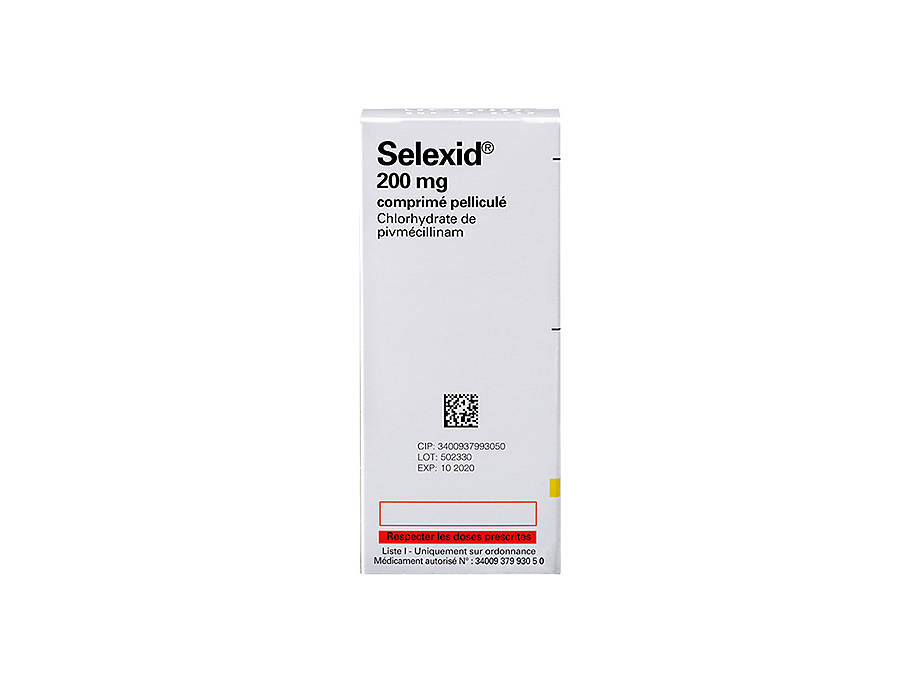
Selexid 200 mg Film-coated Tablets
Marketing authorisation holder
LEO Laboratories Limited
Horizon
Honey Lane
Hurley
Maidenhead
Berkshire
SL6 6RJ
UK
Special precautions for storage
Store below 25°C in a dry place.
Nature and contents of container
Aluminium/PVC-Aluminium blister packs containing 10 or 18 tablets.
Marketing authorisation number(s)
PL 00043/0048
Qualitative and quantitative composition
Pivmecillinam hydrochloride 200 mg
Special warnings and precautions for use
During long term use, it is advisable to carry out routine liver and kidney function tests.
Pseudomembranous colitis caused by Clostridium difficile may occur. If diarrhoea occurs after use, the possibility of pseudomembranous colitis should be considered, and appropriate actions should be taken.
Selexid tablets should be used with caution in patients with porphyria since pivmecillinam has been associated with acute attacks of porphyria.
As with other antibiotics which are excreted mainly by the kidneys, raised blood levels of mecillinam may occur if repeated doses are given to patients with impaired renal function.
Selexid tablets should be used with caution for long-term or frequently-repeated treatment, due to the possibility of carnitine depletion. Symptoms of carnitine depletion include muscle aches, fatigue, and confusion.
Concurrent treatment with valproic acid, valproate or other medication liberating pivalic acid should be avoided due to increased risk of carnitine depletion.
The tablets must be taken with at least half a glass of fluid due to risk of oesophageal ulceration.
Effects on ability to drive and use machines
Selexid has no or negligible influence on the ability to drive or use machines.
Dosage (Posology) and method of administration
Posology
Adults and children weighing more than 40 kg:
Urinary tract infections:
- Acute uncomplicated cystitis: 72 hour course of 2 tablets immediately followed by 1 tablet 3 times daily to a total of 10 tablets.
- Chronic or recurrent bacteriuria: 2 tablets three to four times daily.
Salmonellosis:
- Enteric fever: 1.2-2.4 g daily for 14 days.
- Salmonella carriers: 1.2-2.4 g daily for 2-4 weeks.
Children weighing less than 40 kg:
- Urinary tract infections: 20-40 mg/kg body weight, daily, in 3 to 4 divided doses.
- Salmonellosis: 30-60 mg/kg body weight, daily, in 3 to 4 divided doses.
Dosage in the elderly:
Renal excretion of mecillinam is delayed in the elderly, but significant accumulation of the drug is not likely at the recommended adult dosage of Selexid tablets.
Method of administration
Route of administration is oral. The tablets must be taken with at least half a glass of fluid, and preferably taken with or immediately after a meal.
Special precautions for disposal and other handling
No special requirements for disposal.
Date of first authorisation/renewal of the authorisation
Date of first authorisation: 20 May 1977
Date of last renewal: 29 October 2004