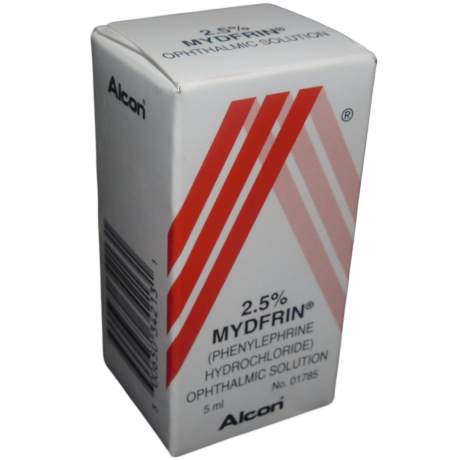
Travellers familiar with Mydfrin from one regional market are unlikely to encounter the same brand everywhere — it is registered in only nine countries. The active ingredient is phenylephrine hydrochloride, a molecule classified within the alpha-adrenomimetic and vasoconstrictive categories, with formulations that fall under both ophthalmologicals and nasal preparations depending on the product line.
Phenylephrine is used in the symptomatic management of conditions associated with nasal congestion, including the common cold and influenza-related blocked nose, where its vasoconstrictive action on local blood vessels underpins its inclusion in decongestant products. In ophthalmic use, the same molecule sits within the mydriatic-cycloplegic category. The structured indication block further down this page lists the registered uses recognised by the regulators in the markets where Mydfrin is sold.
The Mydfrin brand has a scattered international footprint rather than a single regional cluster, with marketing authorisation in countries as geographically varied as Canada, the Philippines, Turkey, Chile, and Hong Kong. Outside this small set of markets the brand is largely unfamiliar, but phenylephrine itself is one of the most broadly available decongestant and ophthalmic ingredients in the world, sold under a wide range of brand names and product formats.
A traveller or expatriate who has been using Mydfrin and is now in a country where the brand is not stocked will usually find a phenylephrine-containing equivalent locally — sometimes as a nasal product, sometimes as an ophthalmic one, depending on the original use. A local pharmacist is well-placed to identify the appropriate regional product. Any decision to start, switch, or substitute should be made together with a healthcare provider who knows the patient's circumstances.
Incompatibilities
Not applicable.
Preclinical safety data
There are no preclinical data of relevance to the prescriber which are additional to that already included in other sections of the SPC.
Pharmacodynamic properties
Phenylephrine is a sympathomimetic agent with mainly direct effects on adrenergic receptors. It has predominantly alpha adrenergic activity and is without stimulating effects on the central nervous system. The sympathomimetic effect of phenylephrine produces vasoconstriction which in turn relieves nasal congestion.
Pharmacokinetic properties
Phenylephrine is readily absorbed after oral administration but is subject to extensive presystemic metabolism, much of which occurs in the enterocytes. As a consequence, systemic bioavailability is only about 40%. Following oral administration, peak plasma concentrations are achieved in 1-2 hours. The mean plasma half life is in the range 2-3 hours. Penetration into the brain appears to be minimal.
Following absorption, the drug is extensively metabolised in the liver. Both phenylephrine and its metabolites are excreted in the urine.
The volume of distribution is between 200 and 500 litres, but there are no data on the extent of plasma protein binding.
Special precautions for disposal and other handling
Not applicable.