Overdose
PillsSuspension for injection
Colchicum-Disperte has a narrow therapeutic window and is extremely toxic in overdose. Patients at particular risk of toxicity are those with renal or hepatic impairment, gastrointestinal or cardiac disease, and patients at extremes of age.
Following Colchicum-Disperte overdose, all patients, even in the absence of early symptoms, should be referred for immediate medical assessment.
Clinical:
Symptoms of acute overdosage may be delayed (3 hours on average): nausea, vomiting, abdominal pain, hemorrhagic gastroenteritis, volume depletion, electrolyte abnormalities, leukocytosis, hypotension in severe cases. The second phase with life threatening complications develops 24 to 72 hours after drug administration: multisystem organ dysfunction, acute renal failure, confusion, coma, ascending peripheral motor and sensory neuropathy, myocardial depression, pancytopenia, dysrhythmias, respiratory failure, consumption coagulopathy. Death is usually a result of respiratory depression and cardiovascular collapse. If the patient survives, recovery may be accompanied by rebound leukocytosis and reversible alopecia starting about one week after the initial ingestion.
Treatment:
No antidote is available.
Elimination of toxins by gastric lavage within one hour of acute poisoning.
Consider oral activated charcoal in adults who have ingested more than 0.1mg/kg bodyweight within 1 hour of presentation and in children who have ingested any amount within 1 hour of presentation.
Haemodialysis has no efficacy (high apparent distribution volume).
Close clinical and biological monitoring in hospital environment.
Symptomatic and supportive treatment: control of respiration, maintenance of blood pressure and circulation, correction of fluid and electrolytes imbalance.
The lethal dose varies widely (7-65 mg single dose) for adults but is generally about 20 mg.
Colchicum-Dispert has a narrow therapeutic window and is extremely toxic in overdose. Patients at particular risk of toxicity are those with renal or hepatic impairment, gastrointestinal or cardiac disease, and patients at extremes of age.
Following Colchicum-Dispert overdose, all patients, even in the absence of early symptoms, should be referred for immediate medical assessment.
Clinical:
Symptoms of acute overdosage may be delayed (3 hours on average): nausea, vomiting, abdominal pain, hemorrhagic gastroenteritis, volume depletion, electrolyte abnormalities, leukocytosis, hypotension in severe cases. The second phase with life threatening complications develops 24 to 72 hours after drug administration: multisystem organ dysfunction, acute renal failure, confusion, coma, ascending peripheral motor and sensory neuropathy, myocardial depression, pancytopenia, dysrhythmias, respiratory failure, consumption coagulopathy. Death is usually a result of respiratory depression and cardiovascular collapse. If the patient survives, recovery may be accompanied by rebound leukocytosis and reversible alopecia starting about one week after the initial ingestion.
Treatment:
No antidote is available.
Elimination of toxins by gastric lavage within one hour of acute poisoning.
Consider oral activated charcoal in adults who have ingested more than 0.1mg/kg bodyweight within 1 hour of presentation and in children who have ingested any amount within 1 hour of presentation.
Haemodialysis has no efficacy (high apparent distribution volume).
Close clinical and biological monitoring in hospital environment.
Symptomatic and supportive treatment: control of respiration, maintenance of blood pressure and circulation, correction of fluid and electrolytes imbalance.
The lethal dose varies widely (7-65 mg single dose) for adults but is generally about 20 mg.
Contraindications
PillsSuspension for injection
-
- Patients with blood dyscrasias
- Pregnancy
- Breastfeeding
- Women of childbearing potential unless using effective contraceptive measures
- Patients with severe renal impairment
- Patients with severe hepatic impairment
- Colchicum-Disperte should not be used in patients undergoing haemodialysis since it cannot be removed by dialysis or exchange transfusion.
- Colchicum-Disperte is contraindicated in patients with renal or hepatic impairment who are taking a P-glycoprotein (P-gp) inhibitor or a strong CYP3A4 inhibitor
-
- Patients with blood dyscrasias
- Pregnancy
- Breastfeeding
- Women of childbearing potential unless using effective contraceptive measures
- Patients with severe renal impairment
- Patients with severe hepatic impairment
- Colchicum-Dispert should not be used in patients undergoing haemodialysis since it cannot be removed by dialysis or exchange transfusion.
- Colchicum-Dispert is contraindicated in patients with renal or hepatic impairment who are taking a P-glycoprotein (P-gp) inhibitor or a strong CYP3A4 inhibitor
Incompatibilities
None known.
Undesirable effects
The following adverse reactions have been observed.
The frequencies are listed under one of the following classifications:
Very common > 1/10
Common > 1/100 and < 1/10
Uncommon > 1/1000 and < 1/100
Rare > 1/10 000 and < 1/1000
Very rare < 1/10 000
Not known (cannot be estimated from the available data)
Blood and lymphatic system disorders
Not known: bone marrow depression with agranulocytosis, aplastic anaemia and thrombocytopenia.
Nervous system disorders
Not known: peripheral neuritis, neuropathy.
Gastrointestinal system disorders
Common: abdominal pain, nausea, vomiting and diarrhoea.
Not known: gastrointestinal haemorrhage.
Hepatobiliary disorders
Not known: hepatic damage.
Skin and subcutaneous tissue disorders
Not known: alopecia, rash.
Musculoskeletal and connective tissue disorders
Not known: myopathy and rhabdomyolysis.
Renal and urinary disorders
Not known: renal damage.
Reproductive system and breast disorders
Not known: amenorrhoea, dysmenorrhoea, oligospermia, azoospermia.
Reporting of suspected adverse reactions
Reporting suspected adverse reactions after authorisation of the medicinal product is important. It allows continued monitoring of the benefit/risk balance of the medicinal product. Healthcare professionals are asked to report any suspected adverse reactions via the Yellow Card Scheme at www.mhra.gov.uk/yellowcard.
Preclinical safety data
PillsSuspension for injection
Genotoxicity
In one study, a bacterial test indicated that Colchicum-Disperte has a slight mutagenic effect.
However, two other bacterial tests and a test in Drosophila melanogaster found that Colchicum-Disperte was not mutagenic.
Tests have shown that Colchicum-Disperte induces chromosomal aberrations and micronuclei, and causes some DNA damage.
Teratogenicity
Tests in animals have shown that Colchicum-Disperte is teratogenic.
Genotoxicity
In one study, a bacterial test indicated that Colchicum-Dispert has a slight mutagenic effect.
However, two other bacterial tests and a test in Drosophila melanogaster found that Colchicum-Dispert was not mutagenic.
Tests have shown that Colchicum-Dispert induces chromosomal aberrations and micronuclei, and causes some DNA damage.
Teratogenicity
Tests in animals have shown that Colchicum-Dispert is teratogenic.
Therapeutic indications
Adults
- Treatment of acute gout
- Prophylaxis of gout attack during initiation of therapy with allopurinol and uricosuric drugs
Pharmacotherapeutic group
drugs for gout, with no effect on uric acid metabolism. ATC code: M04AC01
Pharmacodynamic properties
PillsSuspension for injection
Pharmacotherapeutic group: drugs for gout, with no effect on uric acid metabolism. ATC code: M04AC01
In the AGREE (Acute Gout Flare Receiving Colchicum-Disperte Evaluation) study low- and high-dose Colchicum-Disperte were compared using a randomized, placebo controlled design. The high-dose prolonged Colchicum-Disperte regimen (4.8 mg total over 6 hours) was compared with a placebo and a low-dose abbreviated regimen (1.8 mg total over 1 hour, i.e. 1.2 mg followed by 0.6 mg in 1 hour). Both Colchicum-Disperte regimens were significantly more effective than placebo, with 32.7% responders in the high dose group, 37.8% responders in the low-dose group, and 15.5% responders in the placebo group (P = 0.034 and P = 0.005, respectively, versus placebo). The results at the primary 24hour end point demonstrate superior safety of low dose Colchicum-Disperte, without loss of efficacy, relative to high dose Colchicum-Disperte for early acute gout flare (self-administered within 12 hours of flare onset). The pharmacokinetic analysis performed in this study showed that the Colchicum-Disperte plasma concentration was decreased substantially from about 12 hours after administration in healthy volunteers.
Colchicum-Disperte prophylaxis (0.6 mg twice daily) during initiation of allopurinol for chronic gouty arthritis reduced the frequency and severity of acute flares, and reduced the likelihood of recurrent flares. Treatment may be continued for up to 6 months, based on clinical data. Prospective randomized controlled trials are needed to further evaluate flare prophylaxis for up to 6 months, after 6 months, and over time.
The mechanism of action of Colchicum-Disperte in the treatment of gout is not clearly understood. Colchicum-Disperte is considered to act against the inflammatory response to urate crystals, by possibly inhibiting the migration of granulocytes into the inflamed area. Other properties of Colchicum-Disperte, such as interaction with the microtubules, could also contribute to the operation. Onset of action is approximately 12 hours after oral administration and is maximal after 1 to 2 days.
Pharmacotherapeutic group: drugs for gout, with no effect on uric acid metabolism. ATC code: M04AC01
In the AGREE (Acute Gout Flare Receiving Colchicum-Dispert Evaluation) study low- and high-dose Colchicum-Dispert were compared using a randomized, placebo controlled design. The high-dose prolonged Colchicum-Dispert regimen (4.8 mg total over 6 hours) was compared with a placebo and a low-dose abbreviated regimen (1.8 mg total over 1 hour, i.e. 1.2 mg followed by 0.6 mg in 1 hour). Both Colchicum-Dispert regimens were significantly more effective than placebo, with 32.7% responders in the high dose group, 37.8% responders in the low-dose group, and 15.5% responders in the placebo group (P = 0.034 and P = 0.005, respectively, versus placebo). The results at the primary 24hour end point demonstrate superior safety of low dose Colchicum-Dispert, without loss of efficacy, relative to high dose Colchicum-Dispert for early acute gout flare (self-administered within 12 hours of flare onset). The pharmacokinetic analysis performed in this study showed that the Colchicum-Dispert plasma concentration was decreased substantially from about 12 hours after administration in healthy volunteers.
Colchicum-Dispert prophylaxis (0.6 mg twice daily) during initiation of allopurinol for chronic gouty arthritis reduced the frequency and severity of acute flares, and reduced the likelihood of recurrent flares. Treatment may be continued for up to 6 months, based on clinical data. Prospective randomized controlled trials are needed to further evaluate flare prophylaxis for up to 6 months, after 6 months, and over time.
The mechanism of action of Colchicum-Dispert in the treatment of gout is not clearly understood. Colchicum-Dispert is considered to act against the inflammatory response to urate crystals, by possibly inhibiting the migration of granulocytes into the inflamed area. Other properties of Colchicum-Dispert, such as interaction with the microtubules, could also contribute to the operation. Onset of action is approximately 12 hours after oral administration and is maximal after 1 to 2 days.
Pharmacokinetic properties
PillsSuspension for injection
Colchicum-Disperte is rapidly and almost completely absorbed after oral administration. Maximum plasma concentrations are met usually after 30 to 120 minutes. The terminal half-life is 3 to 10 hours. Plasma protein binding is approximately 30%. Colchicum-Disperte is partially metabolised in the liver and then in part via the bile. It accumulates in leucocytes. Colchicum-Disperte is largely excreted (80%) in unchanged form and as metabolites in the faeces. 10-20% is excreted in the urine.
Renal impairment
Colchicum-Disperte is significantly excreted in urine in healthy subjects. Clearance of Colchicum-Disperte is decreased in patients with impaired renal function. Total body clearance of Colchicum-Disperte was reduced by 75% in patients with end-stage renal disease undergoing dialysis.
The influence of renal impairment on the pharmacokinetics of Colchicum-Disperte was assessed in a study in patients with familial Mediterranean fever (FMF), 5 women and 4 men, with (n=4) and without (n=5) renal impairment. The mean age was 30 years (range 19-42 years). All 5 patients with renal impairment had biopsy-proven amyloidosis; 4 were on routine haemodialysis and 1 had a serum creatinine CL of 15 ml/min. They could therefore be classified as having severe renal impairment. Subjects received 1 mg Colchicum-Disperte except for 1 subject with cirrhosis who received 500 micrograms. A 4-fold decrease in Colchicum-Disperte CL was observed in subjects with renal impairment compared to those with normal renal function (0.168 ± 0.063 l/h/kg vs. 0.727 ± 0.110 l/h/kg). The terminal half-life was 18.8 ± 1.2 h for subjects with severe renal impairment and 4.4 ± 1.0 h for those with normal renal function. The volume of distribution was similar between groups. The patient with cirrhosis had a 10-fold lower CL compared to the subjects with normal renal function.
Paediatric population
No pharmacokinetics data are available in children.
Colchicum-Dispert is rapidly and almost completely absorbed after oral administration. Maximum plasma concentrations are met usually after 30 to 120 minutes. The terminal half-life is 3 to 10 hours. Plasma protein binding is approximately 30%. Colchicum-Dispert is partially metabolised in the liver and then in part via the bile. It accumulates in leucocytes. Colchicum-Dispert is largely excreted (80%) in unchanged form and as metabolites in the faeces. 10-20% is excreted in the urine.
Renal impairment
Colchicum-Dispert is significantly excreted in urine in healthy subjects. Clearance of Colchicum-Dispert is decreased in patients with impaired renal function. Total body clearance of Colchicum-Dispert was reduced by 75% in patients with end-stage renal disease undergoing dialysis.
The influence of renal impairment on the pharmacokinetics of Colchicum-Dispert was assessed in a study in patients with familial Mediterranean fever (FMF), 5 women and 4 men, with (n=4) and without (n=5) renal impairment. The mean age was 30 years (range 19-42 years). All 5 patients with renal impairment had biopsy-proven amyloidosis; 4 were on routine haemodialysis and 1 had a serum creatinine CL of 15 ml/min. They could therefore be classified as having severe renal impairment. Subjects received 1 mg Colchicum-Dispert except for 1 subject with cirrhosis who received 500 micrograms. A 4-fold decrease in Colchicum-Dispert CL was observed in subjects with renal impairment compared to those with normal renal function (0.168 ± 0.063 l/h/kg vs. 0.727 ± 0.110 l/h/kg). The terminal half-life was 18.8 ± 1.2 h for subjects with severe renal impairment and 4.4 ± 1.0 h for those with normal renal function. The volume of distribution was similar between groups. The patient with cirrhosis had a 10-fold lower CL compared to the subjects with normal renal function.
Paediatric population
No pharmacokinetics data are available in children.
Name of the medicinal product
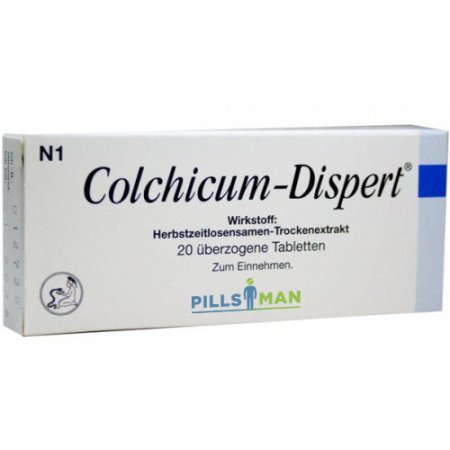
Colchicum-Dispert
Qualitative and quantitative composition
Colchicine
Special warnings and precautions for use
PillsSuspension for injection
Colchicum-Disperte is potentially toxic so it is important not to exceed the dose prescribed by a physician with the necessary knowledge and experience.
Colchicum-Disperte has a narrow therapeutic window. The administration should be discontinued if toxic symptoms such as nausea, vomiting, abdominal pain, diarrhoea occur.
Colchicum-Disperte may cause severe bone marrow depression (agranulocytosis, aplastic anaemia, thrombocytopenia). The change in blood counts may be gradual or very sudden. Aplastic anaemia in particular has a high mortality rate. Periodic checks of the blood picture are essential.
If patients develop signs or symptoms that could indicate a blood cell dyscrasia, such as fever, stomatitis, sore throat, prolonged bleeding, bruising or skin disorders, treatment with Colchicum-Disperte should be immediately discontinued and a full haematological investigation should be conducted straight away.
Caution is advised in case of:
- liver or renal impairment
- cardiovascular disease
- gastrointestinal disorders
- elderly and debilitated patients
- patients with abnormalities in blood counts
Patients with liver or renal impairment should be carefully monitored for adverse effects of Colchicum-Disperte.
Co-administration with P-gp inhibitors and/or moderate or strong CYP3A4 inhibitors will increase the exposure to Colchicum-Disperte, which may lead to Colchicum-Disperte induced toxicity including fatalities. If treatment with a P-gp inhibitor or a moderate or strong CYP3A4 inhibitor is required in patients with normal renal and hepatic function, a reduction in Colchicum-Disperte dosage or interruption of Colchicum-Disperte treatment is recommended.
This medicinal product contains lactose. Patients with rare hereditary problems of galactose intolerance, the Lapp lactase deficiency or glucose-galactose malabsorption should not take this medicine.
Colchicum-Dispert is potentially toxic so it is important not to exceed the dose prescribed by a physician with the necessary knowledge and experience.
Colchicum-Dispert has a narrow therapeutic window. The administration should be discontinued if toxic symptoms such as nausea, vomiting, abdominal pain, diarrhoea occur.
Colchicum-Dispert may cause severe bone marrow depression (agranulocytosis, aplastic anaemia, thrombocytopenia). The change in blood counts may be gradual or very sudden. Aplastic anaemia in particular has a high mortality rate. Periodic checks of the blood picture are essential.
If patients develop signs or symptoms that could indicate a blood cell dyscrasia, such as fever, stomatitis, sore throat, prolonged bleeding, bruising or skin disorders, treatment with Colchicum-Dispert should be immediately discontinued and a full haematological investigation should be conducted straight away.
Caution is advised in case of:
- liver or renal impairment
- cardiovascular disease
- gastrointestinal disorders
- elderly and debilitated patients
- patients with abnormalities in blood counts
Patients with liver or renal impairment should be carefully monitored for adverse effects of Colchicum-Dispert.
Co-administration with P-gp inhibitors and/or moderate or strong CYP3A4 inhibitors will increase the exposure to Colchicum-Dispert, which may lead to Colchicum-Dispert induced toxicity including fatalities. If treatment with a P-gp inhibitor or a moderate or strong CYP3A4 inhibitor is required in patients with normal renal and hepatic function, a reduction in Colchicum-Dispert dosage or interruption of Colchicum-Dispert treatment is recommended.
This medicinal product contains lactose. Patients with rare hereditary problems of galactose intolerance, the Lapp lactase deficiency or glucose-galactose malabsorption should not take this medicine.
Effects on ability to drive and use machines
PillsSuspension for injection
No details are available regarding the influence of Colchicum-Disperte on the ability to drive and use machines. However, the possibility of drowsiness and dizziness should be taken into account.
No details are available regarding the influence of Colchicum-Dispert on the ability to drive and use machines. However, the possibility of drowsiness and dizziness should be taken into account.
Dosage (Posology) and method of administration
PillsSuspension for injection
Posology
Adults
Treatment of acute gout attack:
1 mg (2 tablets) to start followed by 500 micrograms (1 tablet) after 1 hour.
No further tablets should be taken for 12 hours.
After 12 hours, treatment can resume if necessary with a maximum dose of 500 micrograms (1 tablet) every 8 hours until symptoms are relieved.
The course of treatment should end when symptoms are relieved or when a total of 6 mg (12 tablets) has been taken.
No more than 6 mg (12 tablets) should be taken as a course of treatment.
After completion of a course, another course should not be started for at least 3 days (72 hours).
Prophylaxis of gout attack during initiation of therapy with allopurinol and uricosuric drugs:
500 micrograms twice daily.
The treatment duration should be decided after factors such as flare frequency, gout duration and the presence and size of tophi have been assessed.
Patients with renal impairment:
Use with caution in patients with mild renal impairment.).
Patients with hepatic impairment
Use with caution in patients with mild/moderate hepatic impairment. Such patients should be carefully monitored for adverse effects of Colchicum-Disperte.
Elderly:
Use with caution.
Method of Administration
For oral administration
Tablets should be swallowed whole with a glass of water
Posology
Adults
Treatment of acute gout attack:
1 mg (2 tablets) to start followed by 500 micrograms (1 tablet) after 1 hour.
No further tablets should be taken for 12 hours.
After 12 hours, treatment can resume if necessary with a maximum dose of 500 micrograms (1 tablet) every 8 hours until symptoms are relieved.
The course of treatment should end when symptoms are relieved or when a total of 6 mg (12 tablets) has been taken.
No more than 6 mg (12 tablets) should be taken as a course of treatment.
After completion of a course, another course should not be started for at least 3 days (72 hours).
Prophylaxis of gout attack during initiation of therapy with allopurinol and uricosuric drugs:
500 micrograms twice daily.
The treatment duration should be decided after factors such as flare frequency, gout duration and the presence and size of tophi have been assessed.
Patients with renal impairment:
Use with caution in patients with mild renal impairment.).
Patients with hepatic impairment
Use with caution in patients with mild/moderate hepatic impairment. Such patients should be carefully monitored for adverse effects of Colchicum-Dispert.
Elderly:
Use with caution.
Method of Administration
For oral administration
Tablets should be swallowed whole with a glass of water
Special precautions for disposal and other handling
None