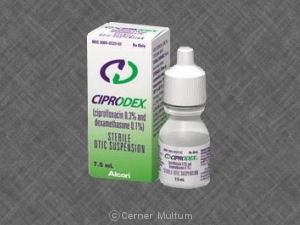
Overdose
Due to the characteristics of this preparation, no toxic
effects are to be expected with an otic overdose of this product.
Contraindications
- CIPRODEX is contraindicated in patients with a history of
hypersensitivity to ciprofloxacin, to other quinolones, or to any of the
components in this medication.
- Use of this product is contraindicated in viral infections
of the external canal including herpes simplex infections and fungal otic
infections.
Undesirable effects
The following serious adverse reactions are described
elsewhere in the labeling:
- Hypersensitivity Reactions
- Potential for Microbial Overgrowth with Prolonged Use
Clinical Trials Experience
Because clinical trials are conducted under widely
varying conditions, adverse reaction rates observed in the clinical trials of a
drug cannot be directly compared to the rates in the clinical trials of another
drug and may not reflect the rates observed in practice.
In Phases II and III clinical trials, a total of 937
patients were treated with CIPRODEX. This included 400 patients with acute
otitis media with tympanostomy tubes and 537 patients with acute otitis
externa. The reported adverse reactions are listed below:
Acute Otitis Media In Pediatric Patients With Tympanostomy
Tubes
The following adverse reactions occurred in 0.5% or more
of the patients with non-intact tympanic membranes.
| Adverse Reactions |
Incidence
(N=400) |
| Ear discomfort |
3.0% |
| Ear pain |
2.3% |
| Ear precipitate (residue) |
0.5% |
| Irritability |
0.5% |
| Taste Perversion |
0.5% |
The following adverse reactions were each reported in a
single patient: tympanostomy tube blockage; ear pruritus; tinnitus; oral
moniliasis; crying; dizziness; and erythema.
Acute Otitis Externa
The following adverse reactions occurred in 0.4% or more
of the patients with intact tympanic Membranes
| Adverse Reactions |
Incidence
(N=537) |
| Ear pruritus |
1.5% |
| Ear debris |
0.6% |
| Superimposed ear infection |
0.6% |
| Ear congestion |
0.4% |
| Ear pain |
0.4% |
| Erythema |
0.4% |
The following adverse reactions were each reported in a
single patient: ear discomfort; decreased hearing; and ear disorder (tingling).
Postmarketing Experience
The following adverse reactions have been identified
during post approval use of CIPRODEX. Because these reactions are reported
voluntarily from a population of unknown size it is not always possible to
reliably estimate their frequency or establish a causal relationship to drug
exposure. These reactions include: auricular swelling, headache,
hypersensitivity, otorrhea, skin exfoliation, rash erythematous, and vomiting.
Therapeutic indications
CIPRODEX is indicated for the treatment of infections
caused by susceptible isolates of the designated microorganisms in the specific
conditions listed below:
- Acute Otitis Media in pediatric patients (age 6 months
and older) with tympanostomy tubes due to Staphylococcus aureus, Streptococcus
pneumoniae, Haemophilus influenzae, Moraxella catarrhalis, and Pseudomonas
aeruginosa.
- Acute Otitis Externa in pediatric (age 6 months and
older), adult and elderly patients due to Staphylococcus aureus and Pseudomonas
aeruginosa.
Pharmacokinetic properties
Following a single bilateral 4-drop (total dose = 0.28
mL, 0.84 mg ciprofloxacin, 0.28 mg dexamethasone) topical otic dose of CIPRODEX
to pediatric patients after tympanostomy tube insertion, measurable plasma
concentrations of ciprofloxacin and dexamethasone were observed at 6 hours following
administration in 2 of 9 patients and 5 of 9 patients, respectively.
Mean ± SD peak plasma concentrations of ciprofloxacin
were 1.39 ± 0.880 ng/mL (n=9). Peak plasma concentrations ranged from 0.543
ng/mL to 3.45 ng/mL and were on average approximately 0.1% of peak plasma
concentrations achieved with an oral dose of 250-mg. Peak plasma concentrations
of ciprofloxacin were observed within 15 minutes to 2 hours post dose
application.
Mean ± SD peak plasma concentrations of dexamethasone
were 1.14 ± 1.54 ng/mL (n=9). Peak plasma concentrations ranged from 0.135
ng/mL to 5.10 ng/mL and were on average approximately 14% of peak concentrations
reported in the literature following an oral 0.5-mg tablet dose. Peak plasma concentrations
of dexamethasone were observed within 15 minutes to 2 hours post dose application.
Dexamethasone has been added to aid in the resolution of
the inflammatory response accompanying bacterial infection (such as otorrhea in
pediatric patients with acute otitis media with tympanostomy tubes).
Date of revision of the text
Dec 2015
Name of the medicinal product
Ciprodex
Fertility, pregnancy and lactation
Teratogenic Effects
Pregnancy Category C
No adequate and well controlled studies with CIPRODEX
have been performed in pregnant women. Caution should be exercised when
CIPRODEX is used by a pregnant woman.
Animal reproduction studies have not been conducted with
CIPRODEX.
Reproduction studies with ciprofloxacin have been
performed in rats and mice using oral doses of up to 100 mg/kg and IV doses up
to 30 mg/kg and have revealed no evidence of harm to the fetus. In rabbits, ciprofloxacin
(30 and 100 mg/kg orally) produced gastrointestinal disturbances resulting in
maternal weight loss and an increased incidence of abortion, but no
teratogenicity was observed at either dose. After intravenous administration of
doses up to 20 mg/kg, no maternal toxicity was produced in therabbit, and no
embryotoxicity or teratogenicity was observed.
Corticosteroids are generally teratogenic in laboratory
animals when administered systemically at relatively low dosage levels. The
more potent corticosteroids have been shown to be teratogenic after dermal
application in laboratory animals.
Qualitative and quantitative composition
Dosage Forms And Strengths
Otic Suspension: Each mL of CIPRODEX contains
ciprofloxacin hydrochloride 0.3 % (equivalent to 3 mg ciprofloxacin base) and
dexamethasone 0.1 % equivalent to 1 mg dexamethasone.
Storage And Handling
CIPRODEX (ciprofloxacin 0.3% and dexamethasone 0.1%)
Sterile Otic Suspension is a white-to off white suspension supplied as follows:
7.5 mL fill in a DROP-TAINER® system. The DROP-TAINER system consists of a
natural polyethylene bottle and natural plug, with a white polypropylene
closure. Tamper evidence is provided with a shrink band around the closure and
neck area of the package.
NDC 0065-8533-02, 7.5 mL fill
Storage
Store at 20° - 25°C (68° - 77°F); excursions permitted to
15° - 30°C (59° - 86°F)..
Avoid freezing. Protect from light.
Distributed by: Alcon Laboratories, Inc., Fort Worth, TX
76134 USA. Revised: Dec 2015
Special warnings and precautions for use
WARNINGS
Included as part of the PRECAUTIONS section.
PRECAUTIONS
Hypersensitivity Reactions
CIPRODEX should be discontinued at the first appearance
of a skin rash or any other sign of hypersensitivity. Serious and occasionally
fatal hypersensitivity (anaphylactic) reactions, some following the first dose,
have been reported in patients receiving systemic quinolones. Some reactions were
accompanied by cardiovascular collapse, loss of consciousness, angioedema
(including laryngeal, pharyngeal or facial edema), airway obstruction, dyspnea,
urticaria and itching.
Potential For Microbial Overgrowth With Prolonged Use
Prolonged use of CIPRODEX may result in overgrowth of
non-susceptible, bacteria and fungi. If the infection is not improved after one
week of treatment, cultures should be obtained to guide further treatment. If
such infections occur, discontinue use and institute alternative therapy.
Continued Or Recurrent Otorrhea
If otorrhea persists after a full course of therapy, or
if two or more episodes of otorrhea occur within six months, further evaluation
is recommended to exclude an underlying condition such as cholesteatoma,
foreign body, or a tumor.
Patient Counseling Information
Advise the patient to read the FDA-approved patient
labeling (PATIENT INFORMATION and Instructions for Use)
- For Otic Use Only
Advise patients that CIPRODEX is for otic use only. This product is not
approved for use in the eye.
- Administration Instructions
Patients should be instructed to warm the bottle in their hand for one to
two minutes prior to use and shake well immediately before using.
- Allergic Reactions
Advise patients to discontinue use immediately and contact their physician,
if rash or allergic reaction occurs.
- Avoid Contamination of the Product
Advise patients to avoid contaminating the tip with material from the ear,
fingers, or other sources.
- Duration of Use
Advise patients that it is very important to use the ear drops for as long
as their doctor has instructed, even if the symptoms improve.
- Protect from Light
Advise patients to protect the product from light.
- Unused Product
Advise patients to discard unused portion after therapy is completed.
Nonclinical Toxicology
Carcinogenesis, Mutagenesis, Impairment Of Fertility
Long-term carcinogenicity studies in mice and rats have
been completed for ciprofloxacin. After daily oral doses of 750 mg/kg (mice)
and 250 mg/kg (rats) were administered for up to 2 years, there was no evidence
that ciprofloxacin had any carcinogenic or tumorigenic effects in these
species. No long term studies of CIPRODEX have been performed to evaluate
carcinogenic potential.
Eight in vitro mutagenicity tests have been conducted
with ciprofloxacin, and the test results are listed below:
- Salmonella/Microsome Test (Negative)
- E. coli DNA Repair Assay (Negative)
- Mouse Lymphoma Cell Forward Mutation Assay (Positive)
- Chinese Hamster V79 Cell HGPRT Test (Negative)
- Syrian Hamster Embryo Cell Transformation Assay
(Negative)
- Saccharomyces cerevisiae Point Mutation Assay
(Negative)
- Saccharomyces cerevisiae Mitotic Crossover and
Gene Conversion Assay (Negative)
- Rat Hepatocyte DNA Repair Assay (Positive)
Thus, 2 of the 8 tests were positive, but results of the
following 3 in vivo test systems gave negative results:
- Rat Hepatocyte DNA Repair Assay
- Micronucleus Test (Mice)
- Dominant Lethal Test (Mice)
Fertility studies performed in rats at oral doses of
ciprofloxacin up to 100 mg/kg/day revealed no evidence of impairment. This
would be over 100 times the maximum recommended clinical dose of ototopical
ciprofloxacin based upon body surface area, assuming total absorption of
ciprofloxacin from the ear of a patient treated with CIPRODEX twice per day
according to label directions.
Long term studies have not been performed to evaluate the
carcinogenic potential of topical otic dexamethasone. Dexamethasone has been
tested for in vitro and in vivo genotoxic potential and shown to be positive in
the following assays: chromosomal aberrations, sister-chromatid exchange in
human lymphocytes, and micronuclei and sister-chromatid exchanges in mouse bone
marrow. However, the Ames/Salmonella assay, both with and without S9 mix, did
not show any increase in His+ revertants.
The effect of dexamethasone on fertility has not been
investigated following topical otic application. However, the lowest toxic dose
of dexamethasone identified following topical dermal application was 1.802
mg/kg in a 26-week study in male rats and resulted in changes to the testes,
epididymis, sperm duct, prostate, seminal vessicle, Cowper's gland and
accessory glands. The relevance of this study for short-term topical otic use
is unknown.
Use In Specific Populations
Pregnancy
Teratogenic Effects
Pregnancy Category C
No adequate and well controlled studies with CIPRODEX
have been performed in pregnant women. Caution should be exercised when
CIPRODEX is used by a pregnant woman.
Animal reproduction studies have not been conducted with
CIPRODEX.
Reproduction studies with ciprofloxacin have been
performed in rats and mice using oral doses of up to 100 mg/kg and IV doses up
to 30 mg/kg and have revealed no evidence of harm to the fetus. In rabbits, ciprofloxacin
(30 and 100 mg/kg orally) produced gastrointestinal disturbances resulting in
maternal weight loss and an increased incidence of abortion, but no
teratogenicity was observed at either dose. After intravenous administration of
doses up to 20 mg/kg, no maternal toxicity was produced in therabbit, and no
embryotoxicity or teratogenicity was observed.
Corticosteroids are generally teratogenic in laboratory
animals when administered systemically at relatively low dosage levels. The
more potent corticosteroids have been shown to be teratogenic after dermal
application in laboratory animals.
Nursing Mothers
Ciprofloxacin and corticosteroids, as a class, appear in
milk following oral administration. Dexamethasone in breast milk could suppress
growth, interfere with endogenous corticosteroid production, or cause other
untoward effects. It is not known whether topical otic administration of ciprofloxacin
or dexamethasone could result in sufficient systemic absorption to produce
detectable quantities in human milk. Because of the potential for unwanted
effects in nursing infants, a decision should be made whether to discontinue
nursing or to discontinue the drug, taking into account the importance of the
drug to the mother.
Pediatric Use
The safety and efficacy of CIPRODEX have been established
in pediatric patients 6 months and older (937 patients) in adequate and
well-controlled clinical trials.
No clinically relevant changes in hearing function were
observed in 69 pediatric patients (age 4 to 12 years) treated with CIPRODEX and
tested for audiometric parameters.
Dosage (Posology) and method of administration
Important Administration Instructions
- CIPRODEX is for otic use only, and not for ophthalmic
use, or for injection.
- Shake well immediately before use.
Dosage
For The Treatment Of Acute Otitis Media In Pediatric
Patients (Age 6 Months And Older) With Tympanostomy Tubes
The recommended dosage regimen through tympanostomy tubes
is as follows:
- Four drops (equivalent to 0.14 mL of CIPRODEX,
(consisting of 0.42 mg of ciprofloxacin and 0.14 mg of dexamethasone))
instilled into the affected ear twice daily for seven days.
- The suspension should be warmed by holding the bottle in
the hand for one or two minutes to avoid dizziness, which may result from the
instillation of a cold suspension.
- The patient should lie with the affected ear upward, and
then the drops should be instilled.
- The tragus should then be pumped 5 times by pushing
inward to facilitate penetration of the drops into the middle ear.
- This position should be maintained for 60 seconds.
Repeat, if necessary, for the opposite ear.
- Discard unused portion after therapy is completed.
For The Treatment Of Acute Otitis Externa (Age 6
Months And Older)
The recommended dosage regimen is as follows:
- Four drops (equivalent to 0.14 mL of CIPRODEX,
(consisting of 0.42 mg ciprofloxacin and 0.14 mg dexamethasone)) instilled into
the affected ear twice daily for seven days.
- The suspension should be warmed by holding the bottle in
the hand for one or two minutes to avoid dizziness, which may result from the
instillation of a cold suspension.
- The patient should lie with the affected ear upward, and
then the drops should be instilled.
- This position should be maintained for 60 seconds to
facilitate penetration of the drops into the ear canal. Repeat, if necessary,
for the opposite ear.
- Discard unused portion after therapy is completed.
Interaction with other medicinal products and other forms of interaction
SIDE EFFECTS
The following serious adverse reactions are described
elsewhere in the labeling:
- Hypersensitivity Reactions
- Potential for Microbial Overgrowth with Prolonged Use
Clinical Trials Experience
Because clinical trials are conducted under widely
varying conditions, adverse reaction rates observed in the clinical trials of a
drug cannot be directly compared to the rates in the clinical trials of another
drug and may not reflect the rates observed in practice.
In Phases II and III clinical trials, a total of 937
patients were treated with CIPRODEX. This included 400 patients with acute
otitis media with tympanostomy tubes and 537 patients with acute otitis
externa. The reported adverse reactions are listed below:
Acute Otitis Media In Pediatric Patients With Tympanostomy
Tubes
The following adverse reactions occurred in 0.5% or more
of the patients with non-intact tympanic membranes.
| Adverse Reactions |
Incidence
(N=400) |
| Ear discomfort |
3.0% |
| Ear pain |
2.3% |
| Ear precipitate (residue) |
0.5% |
| Irritability |
0.5% |
| Taste Perversion |
0.5% |
The following adverse reactions were each reported in a
single patient: tympanostomy tube blockage; ear pruritus; tinnitus; oral
moniliasis; crying; dizziness; and erythema.
Acute Otitis Externa
The following adverse reactions occurred in 0.4% or more
of the patients with intact tympanic Membranes
| Adverse Reactions |
Incidence
(N=537) |
| Ear pruritus |
1.5% |
| Ear debris |
0.6% |
| Superimposed ear infection |
0.6% |
| Ear congestion |
0.4% |
| Ear pain |
0.4% |
| Erythema |
0.4% |
The following adverse reactions were each reported in a
single patient: ear discomfort; decreased hearing; and ear disorder (tingling).
Postmarketing Experience
The following adverse reactions have been identified
during post approval use of CIPRODEX. Because these reactions are reported
voluntarily from a population of unknown size it is not always possible to
reliably estimate their frequency or establish a causal relationship to drug
exposure. These reactions include: auricular swelling, headache,
hypersensitivity, otorrhea, skin exfoliation, rash erythematous, and vomiting.
DRUG INTERACTIONS
No information provided.