Overdose
The toxic effects of an acute overdosage of CAFERGOT® (ergotamine tartrate and caffeine) (ergotamine tartrate
and caffeine tablets, USP) are due primarily to the ergotamine component. The
amount of caffeine is such that its toxic effects will be overshadowed by those
of ergotamine. Symptoms include vomiting, numbness, tingling, pain and cyanosis
of the extremities associated with diminished or absent peripheral pulses; hypertension
or hypotension; drowsiness, stupor, coma, convulsions and shock. A case has
been reported of reversible bilateral papillitis with ring scotomata in a patient
who received five times the recommended daily adult dose over a period of 14
days.
Treatment consists of removal of the offending drug by induction of emesis,
gastric lavage, and catharsis. Maintenance of adequate pulmonary ventilation,
correction of hypotension and control of convulsions and blood pressure are
important considerations. Treatment of peripheral vasospasm should consist of
warmth, but not heat, and protection of the ischemic limbs. Vasodilators may
be beneficial but caution must be exercised to avoid aggravating an already
existent hypotension.
Contraindications
Coadministration of ergotamine with potent CYP 3A4 inhibitors (ritonavir, nelfinavir,
indinavir, erthromycin, clarithromycin, and troleandomycin) has been associated
with acute ergot toxicity (ergotism) characterized by vasospasm and ischemia
of the extremities (see PRECAUTIONS: DRUG INTERACTIONS),
with some cases resulting in amputation. There have been rare reports of cerebral
ischemia in patients on protease inhibitor therapy when CAFERGOT® (ergotamine tartrate and caffeine) (ergotamine
tartrate and caffeine tablets, USP) was coadministered, at least one resulting
in death. Because of the increased risk for ergotism and other serious vasospastic
adverse events, ergotamine use is contraindicated with these drugs and other
potent inhibitors of CYP 3A4 (e.g., ketoconazole, itraconazole) (see WARNINGS:
CYP 3A4 Inhibitors).
CAFERGOT® (ergotamine tartrate and caffeine tablets, USP) may cause fetal
harm when administered to pregnant women. CAFERGOT® (ergotamine tartrate and caffeine) (ergotamine tartrate
and caffeine tablets, USP) is contraindicated in women who are or may become
pregnant. If this drug is used during pregnancy or if the patient becomes pregnant
while taking this product, the patient should be apprised of the potential hazard
to the fetus.
Peripheral vascular disease, coronary heart disease, hypertension, impaired
hepatic or renal function and sepsis.
Hypersensitivity to any of the components.
Undesirable effects
Cardiovascular: Vasoconstrictive complications of a serious nature may occur
at times. These include ischemia, cyanosis, absence of pulse, cold extremities,
gangrene, precordial distress and pain, EKG changes and muscle pains. Although
these effects occur most commonly with long-term therapy at relatively high
doses, they have also been reported with short-term or normal doses. Other cardiovascular
adverse effects include transient tachycardia or bradycardia and hypertension.
Gastrointestinal: Nausea and vomiting.
Neurological: paresthesias, numbness, weakness, and vertigo.
Allergic: Localized edema and itching.
Fibrotic Complications
(see WARNINGS).
Drug Abuse And Dependence: There have been reports of drug abuse and
psychological dependence in patients on CAFERGOT® (ergotamine tartrate and caffeine) (ergotamine tartrate and
caffeine tablets, USP) therapy. Due to the chronicity of vascular headaches,
it is imperative that patients be advised not to exceed recommended dosages
with long-term use to avoid ergotism (see PRECAUTIONS).
Therapeutic indications
CAFERGOT® (ergotamine tartrate and caffeine tablets, USP) are indicated
as therapy to abort or prevent vascular headache, e.g., migraine, migraine variants,
or so-called "histaminic cephalalgia."
Fertility, pregnancy and lactation
Teratogenic Effects
Pregnancy Category X: There are no studies on the placental transfer
or teratogenicity of the combined products of CAFERGOT® (ergotamine tartrate and caffeine) (ergotamine tartrate
and caffeine tablets, USP). Caffeine is known to cross the placenta and has
been shown to be teratogenic in animals. Ergotamine crosses the placenta in
small amounts, although it does not appear to be embryotoxic in this quantity.
However, prolonged vasoconstriction of the uterine vessels and/or increased
myometrial tone leading to reduced myometrial and placental blood flow may have
contributed to fetal growth retardation observed in animals (see CONTRAINDICATIONS).
Nonteratogenic Effects: CAFERGOT® (ergotamine tartrate and caffeine) (ergotamine tartrate and
caffeine tablets, USP) is contraindicated in pregnancy due to the oxytocic effects
of ergotamine (see CONTRAINDICATIONS).
Labor and Delivery: CAFERGOT® (ergotamine tartrate and caffeine
tablets, USP) is contraindicated in labor and delivery due to its oxytocic effect
which is maximal in the third trimester (see CONTRAINDICATIONS).
Nursing Mothers: Ergot drugs are known to inhibit prolactin but there
are no reports of decreased lactation with CAFERGOT® (ergotamine tartrate and caffeine) (ergotamine tartrate
and caffeine tablets, USP). Ergotamine is excreted in breast milk and may cause
symptoms of vomiting, diarrhea, weak pulse and unstable blood pressure in nursing
infants. Because of the potential for serious adverse reactions in nursing infants
from CAFERGOT® (ergotamine tartrate and caffeine tablets, USP), a decision
should be made whether to discontinue nursing or discontinue the drug, taking
into account the importance of the drug to the mother. Pediatric Use: Safety
and effectiveness in pediatric patients have not been established.
Overdosage & Contraindications
OVERDOSE
The toxic effects of an acute overdosage of CAFERGOT® (ergotamine tartrate and caffeine) (ergotamine tartrate
and caffeine tablets, USP) are due primarily to the ergotamine component. The
amount of caffeine is such that its toxic effects will be overshadowed by those
of ergotamine. Symptoms include vomiting, numbness, tingling, pain and cyanosis
of the extremities associated with diminished or absent peripheral pulses; hypertension
or hypotension; drowsiness, stupor, coma, convulsions and shock. A case has
been reported of reversible bilateral papillitis with ring scotomata in a patient
who received five times the recommended daily adult dose over a period of 14
days.
Treatment consists of removal of the offending drug by induction of emesis,
gastric lavage, and catharsis. Maintenance of adequate pulmonary ventilation,
correction of hypotension and control of convulsions and blood pressure are
important considerations. Treatment of peripheral vasospasm should consist of
warmth, but not heat, and protection of the ischemic limbs. Vasodilators may
be beneficial but caution must be exercised to avoid aggravating an already
existent hypotension.
CONTRAINDICATIONS
Coadministration of ergotamine with potent CYP 3A4 inhibitors (ritonavir, nelfinavir,
indinavir, erthromycin, clarithromycin, and troleandomycin) has been associated
with acute ergot toxicity (ergotism) characterized by vasospasm and ischemia
of the extremities (see PRECAUTIONS: DRUG INTERACTIONS),
with some cases resulting in amputation. There have been rare reports of cerebral
ischemia in patients on protease inhibitor therapy when CAFERGOT® (ergotamine tartrate and caffeine) (ergotamine
tartrate and caffeine tablets, USP) was coadministered, at least one resulting
in death. Because of the increased risk for ergotism and other serious vasospastic
adverse events, ergotamine use is contraindicated with these drugs and other
potent inhibitors of CYP 3A4 (e.g., ketoconazole, itraconazole) (see WARNINGS:
CYP 3A4 Inhibitors).
CAFERGOT® (ergotamine tartrate and caffeine tablets, USP) may cause fetal
harm when administered to pregnant women. CAFERGOT® (ergotamine tartrate and caffeine) (ergotamine tartrate
and caffeine tablets, USP) is contraindicated in women who are or may become
pregnant. If this drug is used during pregnancy or if the patient becomes pregnant
while taking this product, the patient should be apprised of the potential hazard
to the fetus.
Peripheral vascular disease, coronary heart disease, hypertension, impaired
hepatic or renal function and sepsis.
Hypersensitivity to any of the components.
Clinical Pharmacology
CLINICAL PHARMACOLOGY
Ergotamine is an alpha adrenergic blocking agent with a direct stimulating
effect on the smooth muscle of peripheral and cranial blood vessels and produces
depression of central vasomotor centers. The compound also has the properties
of serotonin antagonism. In comparison to hydrogenated ergotamine, the adrenergic
blocking actions are less pronounced and vasoconstrictive actions are greater.
Caffeine, also a cranial vasoconstrictor, is added to further enhance the vasoconstrictive
effect without the necessity of increasing ergotamine dosage.
Many migraine patients experience excessive nausea and vomiting during attacks,
making it impossible for them to retain any oral medication. In such cases,
therefore, the only practical means of medication is through the rectal route
where medication may reach the cranial vessels directly, evading the splanchnic
vasculature and the liver.
Qualitative and quantitative composition
CAFERGOT® (ergotamine tartrate and caffeine tablets, USP) for oral administration
are available as:
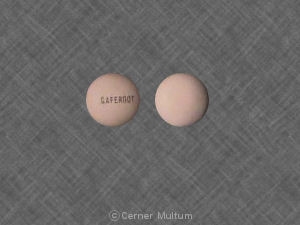
1 mg/100 mg: round tablets, sugar coated beige and imprinted CAFERGOT (ergotamine tartrate and caffeine)
in black ink.
Bottles of 100...................................................NDC
0078-0349-05
Store at controlled room temperature 15° -30° C (59° -86° F).
Dispense in a tight, light-resistant container.
Manufactured By: Geneva Pharmaceuticals, Inc. Broomfield, CO
80020. Distributed By: Novartis Pharmaceuticals Corporation, East Hanover, New
Jersey 07936. Rev 03-2003. FDA Rev date: 7/26/1999
Special warnings and precautions for use
WARNINGS
CYP 3A4 Inhibitors (e.g. Macrolide Antibiotics and Protease Inhibitors):
Coadministration of ergotamine with potent CYP 3A4 inhibitors such as protease
inhibitors or macrolide antibiotics has been associated with serious adverse
events; for this reason, these drugs should not be given concomitantly with
ergotamine (see CONTRAINDICATIONS). While
these reactions have not been reported with less potent CYP 3A4 inhibitors,
there is a potential risk for serious toxicity including vasospasm when these
drugs are used with ergotamine. Examples of less potent CYP 3A4 inhibitors include:
saquinavir, nefazodone, fluconazole, fluoxetine, grapefruit juice, fluvoxamine,
zileuton, metronidazole, and clotrimazole. These lists are not exhaustive, and
the prescriber should consider the effects on CYP 3A4 of other agents being
considered for concomitant use with ergotamine.
Fibrotic Complications: There have been a few reports of patients on
ergotamine tartrate and caffeine therapy developing retroperitoneal and/or pleuropulmonary
fibrosis. There have also been rare reports of fibrotic thickening of the aortic,
mitral, tricuspid, and/or pulmonary valves with long-term continuous use of
ergotamine tartrate and caffeine. Ergotamine tartrate and caffeine tablets should
not be used for chronic daily administration (see DOSAGE AND ADMINISTRATION).
PRECAUTIONS
General: Although signs and symptoms of ergotism rarely develop even
after long-term intermittent use of the orally administered drug, care should
be exercised to remain within the limits of recommended dosage.
Ergotism is manifested by intense arterial vasoconstriction, producing signs
and symptoms of peripheral vascular ischemia. Ergotamine induces vasoconstriction
by a direct action on vascular smooth muscle. In chronic intoxication with ergot
derivatives, headache, intermittent claudication, muscle pains, numbness, coldness
and pallor of the digits may occur. If the condition is allowed to progress
untreated, gangrene can result.
While most cases of ergotism associated with ergotamine treatment result from
frank overdosage, some cases have involved apparent hypersensitivity. There
are few reports of ergotism among patients taking doses within the recommended
limits or for brief periods of time. In rare instances, patients, particularly
those who have used the medication indiscriminately over long periods of time,
may display withdrawal symptoms consisting of rebound headache upon discontinuation
of the drug.
Pregnancy
Teratogenic Effects
Pregnancy Category X: There are no studies on the placental transfer
or teratogenicity of the combined products of CAFERGOT® (ergotamine tartrate and caffeine) (ergotamine tartrate
and caffeine tablets, USP). Caffeine is known to cross the placenta and has
been shown to be teratogenic in animals. Ergotamine crosses the placenta in
small amounts, although it does not appear to be embryotoxic in this quantity.
However, prolonged vasoconstriction of the uterine vessels and/or increased
myometrial tone leading to reduced myometrial and placental blood flow may have
contributed to fetal growth retardation observed in animals (see CONTRAINDICATIONS).
Nonteratogenic Effects: CAFERGOT® (ergotamine tartrate and caffeine) (ergotamine tartrate and
caffeine tablets, USP) is contraindicated in pregnancy due to the oxytocic effects
of ergotamine (see CONTRAINDICATIONS).
Labor and Delivery: CAFERGOT® (ergotamine tartrate and caffeine
tablets, USP) is contraindicated in labor and delivery due to its oxytocic effect
which is maximal in the third trimester (see CONTRAINDICATIONS).
Nursing Mothers: Ergot drugs are known to inhibit prolactin but there
are no reports of decreased lactation with CAFERGOT® (ergotamine tartrate and caffeine) (ergotamine tartrate
and caffeine tablets, USP). Ergotamine is excreted in breast milk and may cause
symptoms of vomiting, diarrhea, weak pulse and unstable blood pressure in nursing
infants. Because of the potential for serious adverse reactions in nursing infants
from CAFERGOT® (ergotamine tartrate and caffeine tablets, USP), a decision
should be made whether to discontinue nursing or discontinue the drug, taking
into account the importance of the drug to the mother. Pediatric Use: Safety
and effectiveness in pediatric patients have not been established.
Dosage (Posology) and method of administration
Procedure: For the best results, dosage should start at the first sign
of an attack. Adults: Take 2 tablets at the start of attack; 1 additional tablet
every 1/2 hour, if needed for full relief (maximum 6 tablets per attack, 10
per week).
Maximum Adult Dosage: Total dose for any one attack should not exceed
6 tablets. Total weekly dosage should not exceed 10 tablets. Ergotamine tartrate
and caffeine tablets should not be used for chronic daily administration. In
carefully selected patients, with due consideration of maximum dosage recommendations,
administration of the drug at bedtime may be an appropriate short-term preventive
measure.
Interaction with other medicinal products and other forms of interaction
SIDE EFFECTS
Cardiovascular: Vasoconstrictive complications of a serious nature may occur
at times. These include ischemia, cyanosis, absence of pulse, cold extremities,
gangrene, precordial distress and pain, EKG changes and muscle pains. Although
these effects occur most commonly with long-term therapy at relatively high
doses, they have also been reported with short-term or normal doses. Other cardiovascular
adverse effects include transient tachycardia or bradycardia and hypertension.
Gastrointestinal: Nausea and vomiting.
Neurological: paresthesias, numbness, weakness, and vertigo.
Allergic: Localized edema and itching.
Fibrotic Complications
(see WARNINGS).
Drug Abuse And Dependence: There have been reports of drug abuse and
psychological dependence in patients on CAFERGOT® (ergotamine tartrate and caffeine) (ergotamine tartrate and
caffeine tablets, USP) therapy. Due to the chronicity of vascular headaches,
it is imperative that patients be advised not to exceed recommended dosages
with long-term use to avoid ergotism (see PRECAUTIONS).
DRUG INTERACTIONS
CYP 3A4 Inhibitors (e.g., Macrolide Antibiotics and Protease Inhibitors):
See CONTRAINDICATIONS and WARNINGS.
CAFERGOT® (ergotamine tartrate and caffeine tablets, USP) should not be
administered with other vasoconstrictors. Use with sympathomimetics (pressor
agents) may cause extreme elevation of blood pressure. The beta-blocker Inderal
(propranolol) has been reported to potentiate the vasoconstrictive action of
CAFERGOT® (ergotamine tartrate and caffeine tablets, USP) by blocking the
vasodilating property of epinephrine. Nicotine may provoke vasoconstriction
in some patients, predisposing to a greater ischemic response to ergot therapy.
The blood levels of ergotamine-containing drugs are reported to be elevated
by the concomitant administration of macrolide antibiotics and vasospastic reactions
have been reported with therapeutic doses of the ergotamine-containing drugs
when coadministered with these antibiotics.