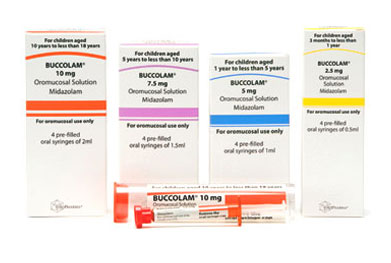
Buccolam is a widely registered anticonvulsant preparation, marketed in 32 countries with a footprint that sits primarily across Europe and neighbouring markets. Its active ingredient is midazolam, a molecule classified across several overlapping categories — anticonvulsant, anxiolytic, sedative, hypnotic, and muscle relaxant — reflecting the broad pharmacology of the benzodiazepine family to which it belongs. This page is written for travellers, expatriates, and family carers trying to identify Buccolam or its equivalents across borders.
Midazolam in this presentation is used in the management of acute, prolonged seizures in patients with epilepsy. It is positioned as an emergency-use medication rather than a daily maintenance therapy, and is often supplied for use by a carer or family member who has been given specific instructions by a treating clinician. The structured indication list further down this page details the registered uses recognised in each market where Buccolam is sold.
Because the brand is registered across a substantial part of the European Economic Area, travellers within that region — for example between France, Germany, Ireland, Iceland, and Israel — frequently encounter the same Buccolam brand on local prescriptions. Outside this cluster, midazolam is broadly available worldwide but typically under different brand names and sometimes in different formulations aimed at hospital or emergency-services use rather than home administration. A pharmacist in the destination country is the right person to confirm what is available locally and in what form.
Other medications within the broader anticonvulsant and benzodiazepine categories are sold internationally, although they are not interchangeable without medical guidance. Families managing epilepsy across borders should treat any change of product, brand, or formulation as a clinical conversation with the prescribing healthcare provider rather than a substitution made at the pharmacy counter.
Incompatibilities
Not applicable
List of excipients
Sodium chloride
Water for injections
Hydrochloric acid (for pH adjustment and conversion of midazolam to the hydrochloride salt)
Sodium hydroxide (for pH adjustment)
Preclinical safety data
In a rat fertility study, animals dosed up to ten times the clinical dose, no adverse effects on fertility were observed.
There are no other preclinical data of relevance to the prescriber which are additional to that already included in other sections of the SmPC.
Date of revision of the text
05/2016
Marketing authorisation holder
Shire Services BVBA
rue Montoyer 47
1000 Brussels
Belgium
Special precautions for storage
Keep the oral syringe in the protective plastic tube.
Do not refrigerate or freeze.
Nature and contents of container
Amber, pre-filled needle-free oral syringe (polypropylene) with plunger (polypropylene) and end cap (high density polyethylene) packed in a protective, capped plastic tube.
|
Strength
|
Volume of solution
|
Syringe volume
|
Age range
|
Label colour
|
|
2.5 mg
|
0.5 ml
|
1 ml
|
3 months to < 1 year
|
Yellow
|
|
5 mg
|
1 ml
|
3 ml
|
1 year to < 5 years
|
Blue
|
|
7.5 mg
|
1.5 ml
|
3 ml
|
5 years to < 10 years
|
Purple
|
|
10 mg
|
2 ml
|
3 ml
|
10 years to < 18 years
|
Orange
|
BUCCOLAM is available in cartons containing 4 pre-filled syringes.
Marketing authorisation number(s)
BUCCOLAM 2.5 mg oromucosal solution
EU/1/11/709/001
BUCCOLAM 5 mg oromucosal solution
EU/1/11/709/002
BUCCOLAM 7.5 mg oromucosal solution
EU/1/11/709/003
BUCCOLAM 10 mg oromucosal solution
EU/1/11/709/004
Special precautions for disposal and other handling
Administration of BUCCOLAM
BUCCOLAM is not for intravenous use.
Step 1
|
|
Hold the plastic tube, break the seal at one end and pull the cap off. Take the syringe out of the tube.
|
Step 2
|
|
Pull the red cap off the tip of the syringe and dispose of it safely.
|
Step 3
|
|
Using the finger and thumb gently pinch and pull back the child's cheek. Put the tip of the syringe into the back of the space between the inside of the cheek and the lower gum.
|
Step 4
|
|
Slowly press the syringe plunger until the plunger stops.
The full amount of solution should be inserted slowly into the space between the gum and the cheek (buccal cavity).
If necessary (for larger volumes and/or smaller patients), approximately half the dose should be given slowly into one side of the mouth, then the other half given slowly into the other side.
|
Any unused medicinal product or waste material should be disposed of in accordance with local requirements.
Date of first authorisation/renewal of the authorisation
Date of first authorisation: 05 September 2011
Date of latest renewal: 26 May 2016