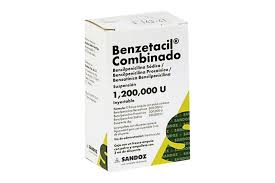
Travellers familiar with Benzetacil from Latin America or southern Europe are unlikely to encounter the same brand elsewhere — it is registered in only five countries. The active ingredient is benzylpenicillin, one of the original members of the penicillin family and classified pharmacologically as a bactericidal agent.
Benzylpenicillin-containing products are prescribed across a wide range of bacterial infections, including respiratory infections such as bronchitis and pneumonia, soft-tissue infections, abscesses, certain sexually transmitted infections such as gonorrhea, Lyme disease, and febrile presentations of bacterial origin. The structured indication list further down this page details each registered use as recognised in the markets where Benzetacil is sold. The drug sits within the broader injectable-penicillin category, which has been a backbone of antibacterial therapy for decades.
Outside its core markets — Brazil, Spain, Venezuela, Ecuador, and Slovenia — the Benzetacil brand itself is uncommon, but benzylpenicillin as a molecule remains available in essentially every regulated healthcare system in the world. A patient prescribed Benzetacil at home and now travelling will, in most countries, find benzylpenicillin available under a different brand name, often as the long-acting benzathine formulation that is standard for several of the indications listed above.
Other antibiotics in the bactericidal penicillin class also circulate widely, although they are not freely interchangeable — choice of agent depends on the specific infection, regional resistance patterns, and patient-level factors. A local pharmacist can usually translate the brand into a regional equivalent based on the active ingredient, but the prescribing decision itself — including whether benzylpenicillin remains the right choice in a given setting — belongs with a healthcare provider familiar with the patient.
Incompatibilities
Powder for solution for injection; Powder for solution for injection and topical application; Powder for solution for intramuscular and subcutaneous administration; Powder for solution for intramuscular injection; Substance-powderPowder for solution for intravenous and intramuscular administration
Benzetacil and solutions that contain metal ions should be administered separately.
Benzetacil should not be administered in the same syringe / giving set as amphotericin B, cimetidine, cytarabine, flucloxacillin, hydroxyzine, methylprednisolone, or promethazine since it is incompatible with these drugs.
In the absence of compatibility studies, this medicinal product must not be mixed with other medicinal products
Benzetacil sodium and solutions that contain metal ions should be administered separately.
Benzetacil sodium should not be administered in the same syringe / giving set as amphotericin B, cimetidine, cytarabine, flucloxacillin, hydroxyzine, methylprednisolone, or promethazine since it is incompatible with these drugs.
In the absence of compatibility studies, this medicinal product must not be mixed with other medicinal products
Preclinical safety data
There are no pre-clinical data of relevance to the prescriber which are additional to that already included in other sections of the SmPC.
Pharmacotherapeutic group
Beta-lactamase sensitive penicillins.
Pharmacokinetic properties
Powder for solution for injection; Powder for solution for injection and topical application; Powder for solution for intramuscular and subcutaneous administration; Powder for solution for intramuscular injection; Substance-powderPowder for solution for intravenous and intramuscular administration
Benzetacil rapidly appears in the blood following intramuscular injection of water-soluble salts and maximum concentrations are usually reached in 15-30 minutes. Peak plasma concentrations of about 12 mcg/ml have been reported after doses of 600 mg with therapeutic plasma concentrations for most susceptible organisms detectable for about 5 hours. Approximately 60% of the dose injected is reversibly bound to plasma protein.
In adults with normal renal function the plasma half-life is about 30 minutes. Most of the dose (60-90%) undergoes renal elimination, 10% by glomerular filtration and 90% by tubular secretion. Tubular secretion is inhibited by probenecid, which is sometimes given to increase plasma penicillin concentrations. Biliary elimination of Benzetacil accounts for only a minor fraction of the dose.
Benzetacil sodium rapidly appears in the blood following intramuscular injection of water-soluble salts and maximum concentrations are usually reached in 15-30 minutes. Peak plasma concentrations of about 12 mcg/ml have been reported after doses of 600 mg with therapeutic plasma concentrations for most susceptible organisms detectable for about 5 hours. Approximately 60% of the dose injected is reversibly bound to plasma protein.
In adults with normal renal function the plasma half-life is about 30 minutes. Most of the dose (60-90%) undergoes renal elimination, 10% by glomerular filtration and 90% by tubular secretion. Tubular secretion is inhibited by probenecid, which is sometimes given to increase plasma penicillin concentrations. Biliary elimination of Benzetacil sodium accounts for only a minor fraction of the dose.
Special precautions for disposal and other handling
After contact with skin, wash immediately with water. In case of contact with eyes, rinse immediately with plenty of water and seek medical advice if discomfort persists.
Any unused medicinal product or waste material should be disposed of in accordance with local requirements.