Overdose
Symptoms and signs
Topically applied benzoyl peroxide is not generally absorbed in sufficient amounts to produce systemic effects.
Excessive application may result in severe irritation. In this event, discontinue use and wait until the skin has recovered.
Treatment
Cold compresses can provide relief from irritation due to excessive application.
Accidental ingestion of topical benzoyl peroxide should be managed clinically or as recommended by the National Poisons Centre, where available.
Contraindications
Patients with a known hypersensitivity to any of the ingredients.
Incompatibilities
None.
Undesirable effects
Adverse reactions are classified by System Organ Class. Adverse reactions that occurred either during clinical studies or that were spontaneously reported are presented below:
Very common >1/10
Common >1/100 to <1/10
Uncommon >1/1000 to <1/100
Rare >1/10000 to <1/1000
Very rare <1/10000
Not known* (cannot be estimated from the available data).
Immune System Disorders
Not known: Allergic reactions, including application site hypersensitivity and anaphylaxis
Skin and Subcutaneous Tissue Disorders
Very Common: Peeling, application site erythema
Common: Dryness, pruritus and contact sensitisation reactions
Uncommon: Burning sensation
Not known: Application site rash
General Disorders and Administration Site Conditions
Not known: Application site discoloration and application site reactions such as irritation and pain
Reporting of suspected adverse reactions
Reporting suspected adverse reactions after authorisation of the medicinal product is important. It allows continued monitoring of the benefit/risk balance of the medicinal product. Healthcare professionals are asked to report any suspected adverse reactions via the Yellow Card Scheme at:www.mhra.gov.uk/yellowcard.
Preclinical safety data
Carcinogenesis/mutagenesis
Both the carcinogenicity and photocarcinogenicity of benzoyl peroxide have been extensively assessed in both mice and hamsters, by various routes of administration, in studies ranging from 42 to 100 weeks in duration. The overall conclusion is that benzoyl peroxide is considered to be generally recognized as a neither carcinogenic nor photocarcinogenic and safe in topical acne products at a concentration of 2.5% to 10%.
The genotoxicity of benzoyl peroxide was extensively assessed in vitro and in vivo. While in a few in vitro studies benzoyl peroxide showed weak mutagenicity, the overall genotoxicity profile did not indicate significant biological relevance.
Reproductive Toxicology
Fertility and Pregnancy
In a combined repeat- dose and reproduction/development toxicity study, benzoyl peroxide (250, 500 or 1,000 mg/kg/day) was administered orally to male rats for 29 days and female rats for 41-51 days. There were no treatment-related changes observed in the mating period, mating rate, conception rate, delivery rate, birth rate, pregnancy period, luteinization number, implantation number and the rate of losing embryos and foetuses after implantation. In pups, body weight was significantly decreased in the high-dose group. The no-observed-adverse-effect-level (NOAEL) for reproductive toxicities was considered to be 500 mg/kg/day.
Therapeutic indications
The product is indicated for use in the topical treatment of acne vulgaris.
Pharmacotherapeutic group
Benzoyl peroxide
Pharmacodynamic properties
Pharmacotherapeutic group: Benzoyl peroxide
ATC code: D10AE01
Mechanism of action
Benzoyl peroxide is a highly lipophilic oxidizing agent with bacteriocidal and keratolytic effects.
Pharmacodynamic effects
The effectiveness of benzoyl peroxide in the treatment of acne vulgaris is primarily attributable to its antibacterial activity, especially with respect to Propionibacterium acnes. The antibacterial activity of benzoyl peroxide is due to the release of active or free-radical oxygen capable of oxidising bacterial proteins. Benzoyl peroxide is also believed to be effective in the treatment of acne on account of its anti-inflammatory and mild keratolytic properties.
Pharmacokinetic properties
Absorption/Distribution/Metabolism
Benzoyl peroxide is absorbed by the skin where it is metabolised to benzoic acid. Following topical application, less than 5% of the dose enters systemic circulation as benzoic acid.
Elimination
Benzoyl peroxide is excreted as benzoic acid in the urine.
Name of the medicinal product
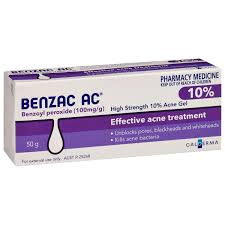
Benzac AC
Special warnings and precautions for use
Avoid contact with the eyes, eyelids, mouth, lips and other mucous membranes. Contact with broken skin should be avoided. Care should be taken when applying the product to the neck and other sensitive areas.
During the first few weeks of treatment a sudden increase in peeling and reddening will occur in most patients and will normally subside in a day or two if treatment is temporarily discontinued.
Patients should be advised that excessive application will not improve efficacy, but may increase the risk of skin irritation.
Concomitant topical acne therapy should be used with caution because a possible cumulative irritancy may occur, which sometimes may be severe, especially with the use of peeling, desquamating, or abrasive agents.
If severe local irritancy occurs (e.g. severe erythema, severe dryness and itching, severe stinging/burning sensation), benzoyl peroxide should be discontinued.
As benzoyl peroxide may cause increased sensitivity to sunlight, sunlamps should not be used and deliberate or prolonged exposure to sunlight should be avoided or minimised. When exposure to strong sunlight cannot be avoided, patients should be advised to use a sunscreen product and wear protective clothing.
The product may bleach hair and coloured or dyed fabrics. Avoid contact with hair, fabrics, furniture or carpeting.
Benzac AC 10 Aquagel contains propylene glycol. Propylene glycol may cause skin irritation.
Effects on ability to drive and use machines
Not Relevant
Dosage (Posology) and method of administration
Treatment should normally begin with Benzac AC Aquagel 2.5. The reaction of the skin to benzoyl peroxide differs in individual patients. The higher concentration in Benzac AC Aquagel 5 or 10 may be required to produce a satisfactory response.
Adults and adolescents
Apply a thin film to the whole of the affected area once daily preferably after washing and drying the skin.
If excessive dryness or peeling occurs application should be temporarily interrupted as per physician instruction or patient tolerability.
Maximum lesion reduction may be expected after approximately eight to twelve weeks of drug use. Continued use is normally required to maintain a clinical response.
Elderly Patients
There are no specific recommendations for use in the elderly.
Paediatric Population
Safety and effectiveness of topical benzoyl peroxide in children under the age of 12 has not been established.
Special precautions for disposal and other handling
There are no special instructions for use or handling of Benzac AC Aquagel 10.