Overdose
Symptoms of severe overdosage are variable. They are characterised in children by various combinations of excitation, ataxia, incoordination, athetosis and hallucinations, while adults may become drowsy and lapse into coma. Convulsions may occur in both adults and children: coma or excitement may precede their occurrence. Cardiorespiratory depression is uncommon. If the patient is seen soon enough after ingestion, it should be possible to induce vomiting with ipecacuanha despite the antiemetic effect of promethazine; alternatively, gastric lavage may be used.
Treatment is otherwise supportive with attention to maintenance of adequate respiratory and circulatory status. Convulsions should be treated with diazepam or other suitable anticonvulsant.
Contraindications
Avomine should not be used in patients in coma or suffering from CNS depression of any cause.
Avomine should not be given to patients with a known hypersensitivity to promethazine or to any of the excipients.
Promethazine is contraindicated for use in children less than two years of age because of the potential for fatal respiratory depression..
Avomine should be avoided in patients taking monoamine oxidase inhibitors up to 14 days previously.
Incompatibilities
Not applicable
Undesirable effects
The following CIOMS frequency rating is used: Very common (>1/10); common (>1/100 to <1/10); uncommon (>1/1000 to <1/100); rare (>1/10 00 to <1/1000); very rare (<1/10 000), not known (cannot be estimated from the available data).
Side effects may be seen in a few patients: drowsiness, dizziness, restlessness, headaches, nightmares, tiredness, and disorientation. Anticholinergic side effects such as blurred vision, dry mouth and urinary retention occur occasionally. Infants are susceptible to the anticholinergic effects of promethazine, while other children may display paradoxical hyperexcitability. The elderly are particularly susceptible to the anticholinergic effects and confusion due to promethazine. Other side-effects include urticaria, rash, pruritus, anorexia, gastric irritation, palpitations, hypotension, arrhythmias, extrapyramidal effects, muscle spasms and tic-like movements of the head and face. Anaphylaxis, jaundice and blood dyscrasias including haemolytic anaemia rarely occur. Photosensitive skin reactions have been reported. Strong sunlight should be avoided during treatment.
Reporting of suspected adverse reactions
Reporting suspected adverse reactions after authorisation of the medicinal product is important. It allows continued monitoring of the benefit/risk balance of the medicinal product. Healthcare professionals are asked to report any suspected adverse reactions via Yellow Card Scheme at: www.mhra.gov.uk/yellowcard.
Preclinical safety data
No additional preclinical data of relevance to the prescriber.
Therapeutic indications
As symptomatic treatment for allergic conditions of the upper respiratory tract and skin including allergic rhinitis, urticaria and anaphylactic reactions to drugs and foreign proteins.
As an antiemetic.
For short term use:
Treatment of insomnia in adults.
For short term use as a paediatric sedative.
Pharmacotherapeutic group
Antihistamines for systemic use; Phenothiazine derivatives, ATC code: R06AD02
Pharmacodynamic properties
Pharmacotherapeutic group: Antihistamines for systemic use; Phenothiazine derivatives, ATC code: R06AD02
Potent, long acting, antihistamine with additional anti-emetic central sedative and anti-cholinergic properties.
Pharmacokinetic properties
Promethazine is distributed widely in the body. It enters the brain and crosses the placenta. Promethazine is slowly excreted via urine and bile. Phenothiazines pass into the milk at low concentrations.
Name of the medicinal product
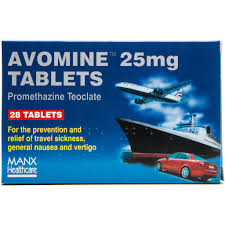
Avomine
Qualitative and quantitative composition
Promethazine
Special warnings and precautions for use
Avomine may thicken or dry lung secretions and impair expectoration. It should therefore be used with caution in patients with asthma, bronchitis or bronchiectasis.
Use with care in patients with severe coronary artery disease, narrow angle glaucoma, epilepsy or hepatic and renal insufficiency.
Caution should be exercised in patients with bladder neck or pyloro-duodenal obstruction.
The use of promethazine should be avoided in children and adolescents with signs and symptoms suggestive of Reye's Syndrome.
Promethazine may mask the warning signs of ototoxicity caused by ototoxic drugs e.g. salicylates. It may also delay the early diagnosis of intestinal obstruction or raised intracranial pressure through the suppression of vomiting.
Patients with rare hereditary problems of galactose intolerance, the Lapp lactase deficiency or glucose-galactose malabsorption should not take this medicine.
Avomine should not be used for longer than 7 days without seeking medical advice.
Effects on ability to drive and use machines
Because the duration of action may be up to 12 hours, patients should be advised that if they feel drowsy they should not drive or operate heavy machinery.
Dosage (Posology) and method of administration
Route of administration: Oral.
Not for use in children under the age of 2 years.
As an antihistamine in allergy:
| Children 2-5 years | The use of Avomine Elixir is recommended for this age group. |
| Children 5-10 years | 25 mg as a single dose*. Maximum daily dose 25 mg. |
| Children over 10 years and adults (including elderly) | 25 mg as a single dose*. Increasing to a maximum of 25 mg bd as required. |
*Single doses are best taken at night.
As an antiemetic:
| Children 2-5 years | The use of Avomine Elixir is recommended for this age group. |
| Children 5-10 years | The use of Avomine Elixir or Avomine 10 mg Tablets is recommended. |
| Children over 10 years and adults (including elderly) | 25 mg to be taken the night before the journey. To be repeated after 6-8 hours as required. |
As a paediatric sedative for short term use and for short term treatment of insomnia in adults:
| Children 2-5 years | The use of Avomine Elixir is recommended for this age group. |
| Children 5-10 years | 25 mg as a single night time dose. |
| Children over 10 years and adults (including elderly) | 25 or 50 mg as a single night time dose. |
Special precautions for disposal and other handling
No special requirements