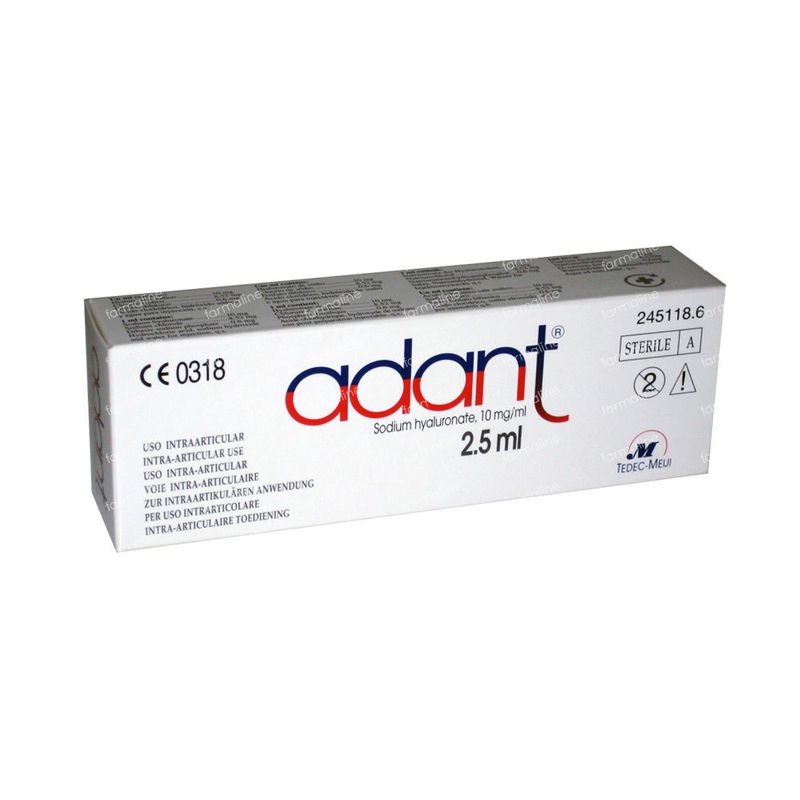
Overdose
No information provided.
Contraindications
At present there are no known contraindications to the use of the Adant OVD when used as recommended.
Undesirable effects
The Adant OVD is extremely well tolerated after injection into human eyes. A transient rise of intraocular pressure postoperatively has been reported in some cases.
In posterior segment surgery intraocular pressure rises have been reported in some patients, especially in aphakic diabetics, after injection of large amounts of the Adant OVD.
Rarely, postoperative inflammatory reactions (iritis, hypopyon) as well as incidents of corneal edema and corneal decompensation have been reported. Their relationship to the Adant OVD has not been established.
Therapeutic indications
Uses
The Adant OVD is indicated for use as a surgical aid in cataract extraction (intra- and extracapsular), IOL implantation, corneal transplant, glaucoma filtration and retinal attachment surgery.
In surgical procedures in the anterior segment of the eye, instillation of the Adant OVD serves to maintain a deep anterior chamber during surgery, allowing for efficient manipulation with less trauma to the corneal endothelium and other surrounding tissues.
Furthermore, its viscoelasticity helps to push back the vitreous face and prevent formation of a postoperative flat chamber.
In posterior segment surgery the Adant OVD serves as a surgical aid to gently separate, maneuver and hold tissues.The Adant OVD creates a clear field of vision thereby facilitating intra- and post-operative inspection of the retina and photocoagulation.
Qualitative and quantitative composition
Sodium Hyaluronate
Special warnings and precautions for use
WARNINGS
Included as part of the PRECAUTIONS section.
PRECAUTIONS
Those normally associated with the surgical procedure being performed.
Overfilling the anterior or posterior segment of the eye with the Adant OVD may cause increased intraocular pressure, glaucoma, or other ocular damage.
Postoperative intraocular pressure may also be elevated as a result of preexisting glaucoma, compromised outflow and by operative procedures and sequelae thereto, including enzymatic zonulysis, absence of an iridectomy, trauma to filtration structures, and by blood and lenticular remnants in the anterior chamber. Since the exact role of these factors is difficult to predict in any individual case, the following precautions are recommended:
- Don’t overfill the eye chambers with the Adant OVD (except in glaucoma surgery - See Applications section).
- In posterior segment procedures in aphakic diabetic patients special care should be exercised to avoid using large amounts of the Adant OVD.
- Remove some of the Adant OVD by irrigation and/or aspiration at the close of surgery (except in glaucoma surgery - See Applications section).
- Carefully monitor the intraocular pressure, especially during the immediate postoperative period. If significant rises are observed, treat with appropriate therapy.
Care should be taken to avoid trapping air bubbles behind the Adant OVD.
Because the Adant OVD is a highly purified fraction extracted from avian tissues and is known to contain minute amounts of protein, the physician should be aware of potential risks of the type that can occur with the injection of any biological material.
Because of reports of an occasional release of minute rubber particles, presumably formed when the diaphragm is punctured, the physician should be aware of this potential problem. Express a small amount of the Adant OVD from the syringe prior to use, and carefully examine the remainder as it is injected.
Reprocessed cannulas should not be used.
Sporadic reports have been received indicating that the Adant OVD may become ”cloudy” or form a slight precipitate following instillation into the eye.The clinical significance of these reports, if any, is not known since the majority received to date do not indicate any harmful effects on ocular tissues.The physician should be aware of this phenomenon and, should it be observed, remove the cloudy or precipitated material by irrigation and/or aspiration.
In vitro laboratory studies suggest that this phenomenon may be related to interactions with certain concomitantly administered ophthalmic medications.
Use only if solution is clear.
Dosage (Posology) and method of administration
Applications Cataract Surgery - IOL Implantation
A sufficient amount of the Adant OVD is slowly, and carefully introduced (using a cannula or needle) into the anterior chamber.
Injection of the Adant OVD can be performed either before or after delivery of the lens. Injection prior to lens delivery will, however, have the additional advantage of protecting the corneal endothelium from possible damage arising from the removal of the cataractous lens5.The Adant OVD may also be used to coat surgical instruments and the IOL prior to insertion.
Additional Adant OVD can be injected during surgery to replace any Adant OVD lost during surgical manipulation (see PRECAUTIONS section).
Glaucoma Filtration Surgery
In conjunction with performing of the trabeculectomy, the Adant OVD is injected slowly and carefully through a corneal paracentesis to reconstitute the anterior chamber. Further injection of the Adant OVD can be continued allowing it to extrude into the subconjunctival filtration site and through and around the sutured outer scleral flap.
Corneal Transplant Surgery
After removal of the corneal button, the anterior chamber is filled with the Adant OVD.The donor graft can then be placed on top of the bed of Adant OVD and sutured in place.Additional Adant OVD may be injected to replace the Adant OVD lost as a result of surgical manipulation (see PRECAUTIONS section).The Adant OVD has also been used in the anterior chamber of the donor eye prior to trepanation to protect the corneal endothelial cells of the graft5.
Retinal Attachment Surgery
The Adant OVD is slowly introduced into the vitreous cavity. By directing the injection, the Adant OVD can be used to separate membranes (e.g. epiretinal membranes) away from the retina for safe excision and release of traction.The Adant OVD also serves to maneuver tissues into the desired position, e.g. to gently push back a detached retina or unroll a retinal flap, and aids in holding the retina against the sclera for reattachment.
Instructions Sterile Opening Technique
Tear off the paper covering.
Bend the plastic backwards at the central indentation so as to fully expose the white plastic rod.
Dislodge syringe and place onto sterile field.
Assembly
Press the vial completely into the holder so that the needle perforates the membrane.
Important
Perforate the membrane before screwing on the plastic rod.
Remove the plastic rod.
Screw the plastic rod into the blue plunger.
Connect the cannula and check for proper function.
Store at 2 to 8°C (36 to 46°F). For single use only